

Alpha School, an “AI-powered private school” that heavily relies on AI to teach students and can cost up to $65,000 a year, is AI-generating faulty lesson plans that internal company documentation find sometimes do “more harm than good,” and scraping data from a variety of other online courses without permission to train its own AI, according to former Alpha School employees and internal company documents.
Alpha School has earned fawning coverage from Fox News and The New York Times and received praise from Linda McMahon, the Trump-appointed Secretary of Education, for using generative AI to chart the future of education. But samples of poorly constructed AI-generated lessons that I have viewed present students with unclear wording and illogical choices in multiple choice questions.
“These questions not only fail to meet SAT standards but also fall short of the quality we promise to deliver,” one employee wrote in the company’s Workflowy, a company-wide note taking app where every employee can see what other employees are working on, including their progress and thoughts on various projects. “From a student’s perspective, when answer options don’t logically fit the question, it feels like a betrayal of their effort to learn and succeed. How can we expect students to trust our assessments when the very questions meant to test their knowledge are flawed?”
My investigation into Alpha School also reveals that the massive amounts of data the company collects on students, including videos of them, is stored in a Google Drive folder that anyone with the link—even if they’ve left the company, or if it was sent to them—could access. In turn, that sensitive material is viewed by more Alpha School employees than students and parents may realize.
Former Alpha School employees told me that the company’s increasing reliance on generative AI in every aspect of its operation, as well as the constant monitoring and tracking of every student’s mouse movements, is making students anxious and does not always provide the quality of education Alpha School advertises to parents.
This investigation provides previously unreported details about how Alpha School builds and uses AI tools and how they fail students in a time when the entire education system is struggling to adopt and adapt to generative AI.
“Students are being treated like guinea pigs,” one former Alpha School employee told me. 404 Media granted the three Alpha School employees we talked to anonymity because they signed non-disclosure agreements with the company.
“We are not computers or algorithms. We are simply people who need breaks. We are people that don’t like being watched through their computers,” one Alpha School student wrote in a feedback form to the company.
The “2 Hour Learning” Pitch
Alpha School is a private school covering kindergarten through 12th grade (K-12) with locations across the United States. It also offers Alpha Anywhere, a remote virtual learning program that offers “a complete at-home school replacement.” The school’s primary selling point is its “2 hour learning” philosophy which promises to give students their required education and prepare them for necessary standardized tests, AP tests, and the SATs in just just two hours of learning. The rest of the day, Alpha School says, can be dedicated to more creative learning, students following their passions, and advanced life skills. Alpha School tells parents that its students’ test scores are in the top 2 percent in the U.S.
Alpha School says it’s able to cram all that learning into a two hour window in large part thanks to “AI tutors” and various AI apps that generate custom lesson plans according to each student’s needs.
“We are not computers or algorithms. We are simply people who need breaks. We are people that don’t like being watched through their computers.”
“All educational content is obsolete. Every textbook, every lesson plan, every test, all of it is obsolete because gen AI is going to be able to deliver a personalized lesson just for you,” Joe Liemandt, Alpha School’s “principal” and the founder of Trilogy, the company that owns many of the apps used by Alpha School, said in a podcast interview published last year.
Alpha School co-founder MacKenzie Price said in an interview with The New York Times Hard Fork podcast that she started her first school in 2014, and that Alpha School has used various learning apps over the years, but that generative AI changed how the company teaches students.
“In 2022 when generative AI started to come out, that’s when we realized we have an opportunity to really make sure that kids are efficiently and effectively learning and we can do a better job of building the personalized learning plans to meet kids where they are. It also completely changed the role of assessments and how great of a feedback tool they are,” she said.
To ensure that students are learning, and in order to improve its lesson plans and teaching strategies, Alpha School also digitally monitors students very closely. Similar to employee monitoring software in the corporate world—what has come to be derogatorily known as bossware—Alpha School keeps track of when students are using its various apps, how long it takes them to complete their exercises, their results, and also records videos of them in order to see whether they are focused or distracted.
Former employees I talked to and internal company documents show Alpha School is striving for a future where it can use AI to build an AI-driven education system with “no humans in the loop.” But at the moment Alpha School students have access to human “guides” that offer help and instruction both at Alpha School physical locations and via video calls with tutors who are located all over the world.
Last year, Secretary of Education Linda McMahon visited an Alpha School campus in Texas where she said she was “blown away” by what she saw. “Harnessing AI thoughtfully will be critical to expanding opportunity and preparing students for tomorrow’s workforce,” she said.
Former Alpha School employees and internal documentation don’t disprove Alpha School students’ high test results, but show that students often have to study more than two hours a day, that they sometimes arrive at Alpha high school classes unprepared and below grade level reading skills, and that some students had to go back and fill holes in their education before they were prepared for high school level classes.
One former employee told me some students succeeded despite AI generated materials thanks to human intervention and tutors who cared deeply about their education. The same former employee also emphasized that most of the teaching that wasn’t provided by one of Alpha School’s human tutors was low quality either because it was AI-generated, or wholly lifted from other online teaching services that offer their services for as little as $40, while Alpha School costs tens of thousands of dollars a year.
“Students incoming into AP Biology the previous year were seriously lacking in their foundational skills,” one former Alpha School employee said. The same employee said these students “struggled” and were “really frustrated,” so “[Alpha School] gave them the prerequisite courses and made them do a lot of testing before entering the AP classes.”
Illogical AI Questions
One piece of software that’s central to Alpha School’s education is AlphaRead, which teaches students reading comprehension starting in grade school, up to high school and SAT preparation.
AlphaRead uses existing large language models (LLMs) from companies like OpenAI, Google, and Anthropic to generate articles that cater to students’ level and interests, then tests their reading comprehension by asking them multiple choice questions about the articles they read. Former employees and internal Alpha School documentation show that, sometimes, the exercises AlphaRead generated failed to teach students necessary skills, especially at the high school level.
“Poorly constructed questions do more harm than good.”
“Questions should necessitate passage comprehension,” one Alpha School employee who was tasked with testing AlphaRead wrote in his evaluation of the software. “Alarmingly, some questions in the course can be answered without even reading the article. The SAT Reading section is designed to test a student’s comprehension and engagement with the text; anything less does a disservice to their preparation. These questions are extremely easy for students. They don’t require any deep thinking or analysis, which means students aren’t being challenged to develop the critical reasoning skills they’ll need for the SAT.”
In other instances, AlphaRead suffered from “hallucinations” that are common across all LLMs and presented students with illogical questions.
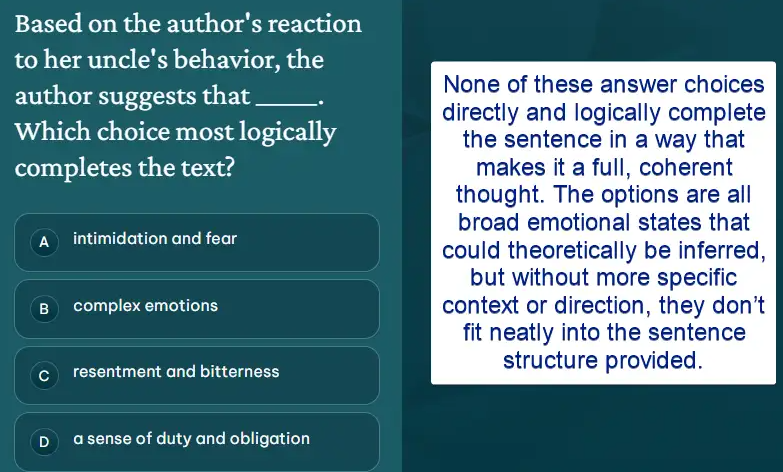
“Poorly constructed questions do more harm than good,” another Alpha School employee testing AlphaRead wrote. “They confuse students with unclear wording and illogical choices, undermining their trust in the assessment process. These questions not only fail to meet SAT standards but also fall short of the quality we promise to deliver.”
The employee specifically cited the question in the screenshot below, which doesn’t make grammatical sense, and, as they note, doesn’t allow the student to make a choice “to complete the sentence in a way that makes it a full, coherent thought.”
“When a student requires help with additional questions, the chatbot fails to identify which specific question is being addressed,” an internal Alpha School document outlining issues with AlphaRead says. “Accuracy of the content provided by the [AI] tutor is a concern. There are instances where it not only delivers incorrect answers but also provides convincing yet flawed justifications. Despite raising multiple queries about a particular answer, the chatbot erroneously confirmed an incorrect option as correct.”
While employees often test Alpha School software as they work to improve it, low quality questions end up in front of students because the process for creating them is largely automated, according to internal company documents and former employees. Employees scrape the internet for existing learning materials, feed those into whatever LLM they think is best at any given moment, and write prompts to generate questions according to their needs, according to internal documents and former employees.
Assessing which materials are worth scraping for training data, what third party apps might be suitable for students, and checking students’ work all heavily rely on LLMs at Alpha School.
“You are an experienced educational content evaluator tasked with grading a ‘worked example’ educational video,” reads one AI prompt written by an Alpha School employee for evaluating the quality of educational videos. “Your goal is to provide a comprehensive and balanced evaluation across several categories, focusing on how well the video serves as a learning resource for students and how effectively it achieves its overall goal.”
“You are an AI assistant tasked with creating a 20-question multiple-choice test based on the provided JSON document,” reads another prompt from an employee working on materials for a science class.
Despite thoroughly documenting the AI-generated errors in its lesson plans, Alpha School relies on AI to test the quality of its AI-generated lessons, creating a situation where a faulty AI is tasked with fixing its own faulty generations.
A note in the company Workflowy showed that generative AI had at least a 10 percent hallucination rate that made it unsuitable to generate explanations of articles for students.
“Students complained about question quality a lot since the transition to AlphaRead,” one employee wrote in the company Workflowy. “I conducted manual QC [quality control] on random articles for a week to locate questions with issues and provide feedback to the developers.” The employee wrote that he found “Questions about sections not in the article; Questions with multiple plausible correct answers; Multipart questions presented in the wrong order; Questions about a specific part of an article that contradict further sections.”
Scraping Without Permission
In October, Wired reported that IXL, an online learning platform that was used by Alpha School students, deactivated Alpha School’s account and said Alpha School is “no longer an IXL customer due to violating our terms of service.” Former Alpha School employees told me they don’t know why Alpha School’s IXL account was deactivated, but that Alpha School regularly uses other online learning platforms’ materials in a way that violates their terms of service, either by copying their materials or by scraping them wholesale as training data for its own AI products.
According to the company’s Workflowy, several employees were working on something called the IXL Replacement Project, which involved evaluating other online learning platforms as suitable IXL replacements for Alpha School’s purposes. It’s not clear if the plan to replace IXL at that point had anything to do with IXL eventually terminating Alpha School’s account.
Alpha School focused on the famous free online learning platform Khan Academy as a potential target, and multiple Alpha School employees heavily relied on AI tools to evaluate Khan Academy’s materials and how well they matched what the company was getting from IXL.
“First, I created a spreadsheet containing the Khan Academy 4th-grade curriculum, which encompasses the specific Khan 4th-grade activities (i.e., exercises, videos, and articles) along with their associated lesson, unit, and CCSS [Common Core State Standards],” wrote one Alpha School employee, explaining their process. “Then, I built a custom GPT tailored for IXL vs Khan mapping. I fed it with the spreadsheet above, and provided specific step-by-step instructions on how to do the mapping. I even enabled it to directly access Khan Academy’s website.”
We don’t know how exactly Alpha School eventually replaced IXL. But at the moment Alpha School uses Khan Academy, branded as Nice Academy. Nice Academy has the exact same content as Khan Academy, the same user interface, and even embeds Khan Academy videos, but the site students use to access this content uses the Nice Academy logo and does not mention Khan.
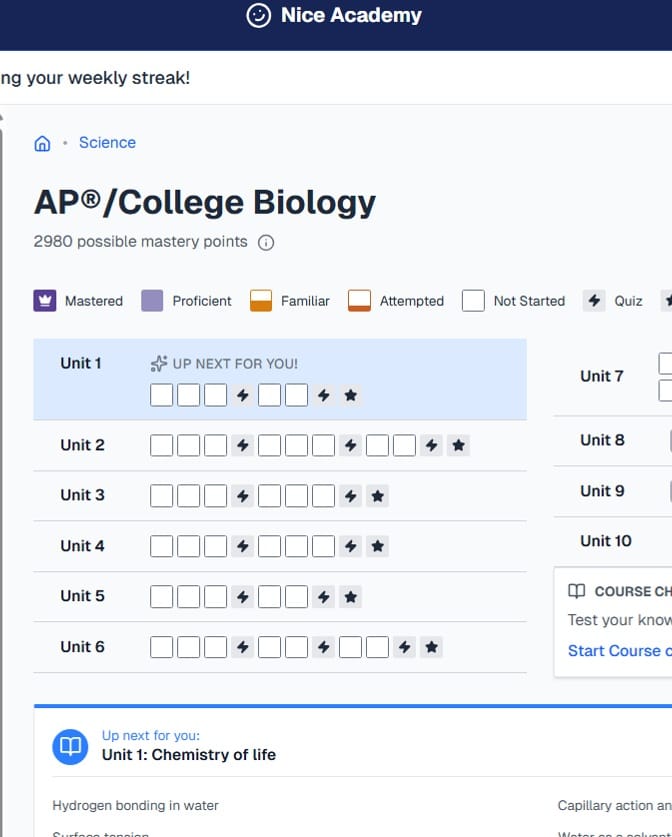
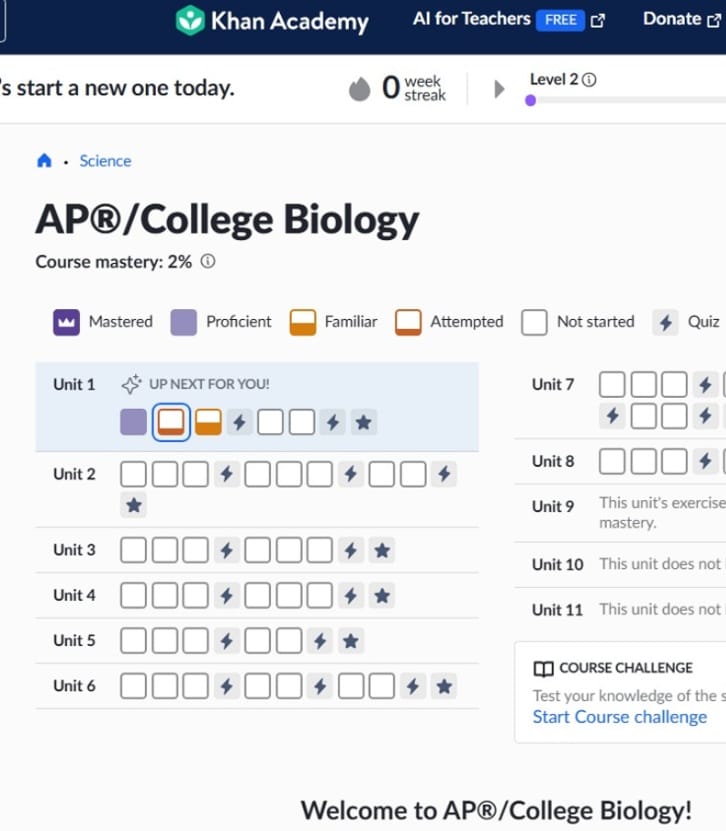
“Our Terms of Service state that users may not scrape our site for content or data, use our content or data to train machine learning models or AI, reproduce or replicate our service, or use our materials for commercial purposes,” a Khan Academy spokesperson told me.
IXL did not respond to a request for comment.
The Alpha School Workflowy also makes several references to scrapped plans to use content from Albert.io, a company that makes interactive learning content for grades 5-12. One note references a meeting with Ablert.io that “was cancelled citing ‘past violations of Terms of Use […] Albert.io id [sic] no longer doing business with Trilogy.” A former Alpha School employee told me that the company used Albert.io’s materials without permission.
Albert.io did not respond to a request for comment.
The Alpha School Workflowy also includes a section titled “Textbook Scrape Ranking” which lists different existing online resources and courses, why they are ranked highly as a good target for scraping, and their “strengths” and “red flags.” There’s also a “What we should scrape” section outlining which content specifically Alpha School should scrape for its training data.
For example, Core Knowledge Language Arts (CKLA), a Core Knowledge Foundation (CKF) curriculum published in partnership with Amplify, is ranked in the first place “due to its strong alignment with the science of reading, extensive scrapable content, and ease of digital conversion.” The document says Alpha School should scrape it for “phonics and decoding exercises,” “comprehension questions,” and more.
CKF told me that it has no formal relationship with Alpha School, that it was not aware Alpha School was using its materials, and that while some of its materials are available under the Creative Commons non commercial license, Amplify is the exclusive commercial licensee of CKLA materials.
“Use of CKF and Amplify materials to create derivative works or to train artificial intelligence or machine-learning models is prohibited under Amplify’s terms of use and CKLA usage guidelines,” a CKF spokesperson told me.
McGraw-Hill Wonders, a popular K-5 English language arts curriculum, is ranked number 2 on the list “due to its comprehensive scope and sequence, extensive lesson and assessment options, and adaptability to digital formats.” The document says Alpha School should scrape its lesson plans for phonics and phonemic awareness lessons, vocabulary instruction lessons, reading passages and comprehension strategies, end of unit assessments, and diagnostic tests.
McGraw-Hill did not respond to a request for comment.
According to employees and internal company communication, Alpha School directed employees to purchase learning materials from other companies with their own money and then expense the cost.
“you are expected to get some of the required data on your own (basic scraping, OCR [optical character recognition]), said one company employee who was listed in the Workflowy as a subject matter expert on scraping. “@all DON’T get us blocked – only scrape without logging in or from a non-Alpha or ESW account.”
Bossware for Kids
Alpha School’s company Workflowy lists “ideas for enhanced tracking & monitoring of kids beyond screentime data.” The goal, according to the note written in Workflowy, was to monitor the way kids are using apps and then use AI to analyze that activity, flag inappropriate behavior like bullying or drug use, and produce a general report about what kids are doing. “Potentially can detect things like changes in friend group or sentiment to flag potential emotional issues to parents,” one bullet point said.
Alpha School identified Bark, an app that allows parents to surveil their children’s online activity, as potentially offering some of these features, but also said it was “pretty limited” in what data it could get on what kids were doing on apps like Instagram. Alpha School then lists what it calls “hacky” ideas beyond “normal APIs” to get more data on what kids are doing. This includes “fake social media accout [sic] bots to follow the kids and collect what they like, post, comment, etc,” and “use the kid’s logins and scraping the data (would give not just public info like from following but also stuff like the DMs).”
Nothing 404 Media has seen in internal Alpha School documents or heard from former employees indicates that the company ever seriously pursued any of these ideas, but close surveillance of students is fundamental to how Alpha School operates.
“The idea of installing software that tracks and records everything our kids do and is designed to not let us turn it off is understandably uncomfortable.”
Alpha School makes an app called StudyReel, which monitors activity on a student’s screen, their computer camera and microphone, what apps and websites they’re using, and how they’re moving their mouse. If StudyReel notices that a student is using an unrelated website or app, idling, or not at their computer, the app can nudge them to get back to work. If StudyReel notices that a student is struggling with a particular question, it can direct them to an AI tutor or assign other lessons that will help them.
Internally and in public messaging, Alpha School refers to these recordings of students as “game tape,” which it reviews in order to help students and improve its teaching. In October, a Wired investigation revealed how this close surveillance upset some students and eventually led their parents to pull them from Alpha School.
The type of surveillance Alpha School uses on students is functionally identical to the type of surveillance used by Crossover, a platform that matches companies with remote workers. Crossover is also owned by Alpha School’s principal Joe Liemandt. Much like Alpha School, Crossover requires employees to install spyware on their computer that records their screens and tracks their mouse movements to make sure they are being productive. Previous reporting described Crossover as a “software sweatshop,” and that the company’s goal is to turn workers into “algorithms” and “human CPUs.”
“I think it would be great if people understand that Alpha School basically has the same psychological effects as Crossover,” one person with knowledge of Alpha School’s software told me.
“The idea of installing software that tracks and records everything our kids do and is designed to not let us turn it off is understandably uncomfortable,” an employee who was listed as the product manager of StudyReel wrote in the Workflowy. “We need to do more to justify it, be better at selling it.”
To do this, the product manager suggested the company “Find StudyReel recordings of students reading the coaching and enjoying it,” and to “Get consent from parents to use it as promotional material (too far?).”
Internally, Alpha School wrote that the “KEY MESSAGE” about StudyReel is that “99% of recordings are never watched by a human” and that “Your data is safe.” However, I saw that Alpha School maintains a spreadsheet which contains a list of student names, their grade, and an archive of their recordings which shows what’s happening on their screen, their remote tutor, and a video of the student taken via their webcam. This spreadsheet is not only available to anyone at the company, but is also shared in such a way that anyone on the internet who has the link can access the spreadsheet and the videos of students.
“If I wanted to, I could go there and just watch students. Anybody who worked in this capacity could watch the videos of students working on their laptops,” one Alpha School employee told me. “So many hours of just students’ faces […] I’m not sure parents understand exactly what’s going on with that data […] I don’t think that this is clearly communicated, because I’m sure there’d be a lot more opt outs if it was.”
Alpha School acknowledged my request for comment but did not provide one in time for publication.
The former Alpha School employees I talked to all agreed that the company’s goal of condensing core education requirements to two hours of learning in order to give students more time for other, more enriching activities is a good, admirable goal. They also agreed that Alpha School students’ test scores are very high compared to the national average, though they credit the human “guides” at Alpha School for that accomplishment.
Alpha School’s cofounder MacKenzie Price also admits in the interview with the Hard Fork Podcast that it’s possible the high test scores could be explained by selection bias. Alpha School is an expensive private school. Most students at Alpha School have parents who are concerned about their education and the financial means to send them there, which might be a bigger determining factor in their academic success. Multiple studies have shown that grades, SAT scores, and standardized tests are highly correlated with income.
The issue according to these former employees is that Alpha School’s two hour learning program usually requires much more than two hours, and more importantly, that the AI products are not working as advertised.
“Basically the claim that this is some AI magic and much more advanced than other tools is incorrect,” one former employee said.