
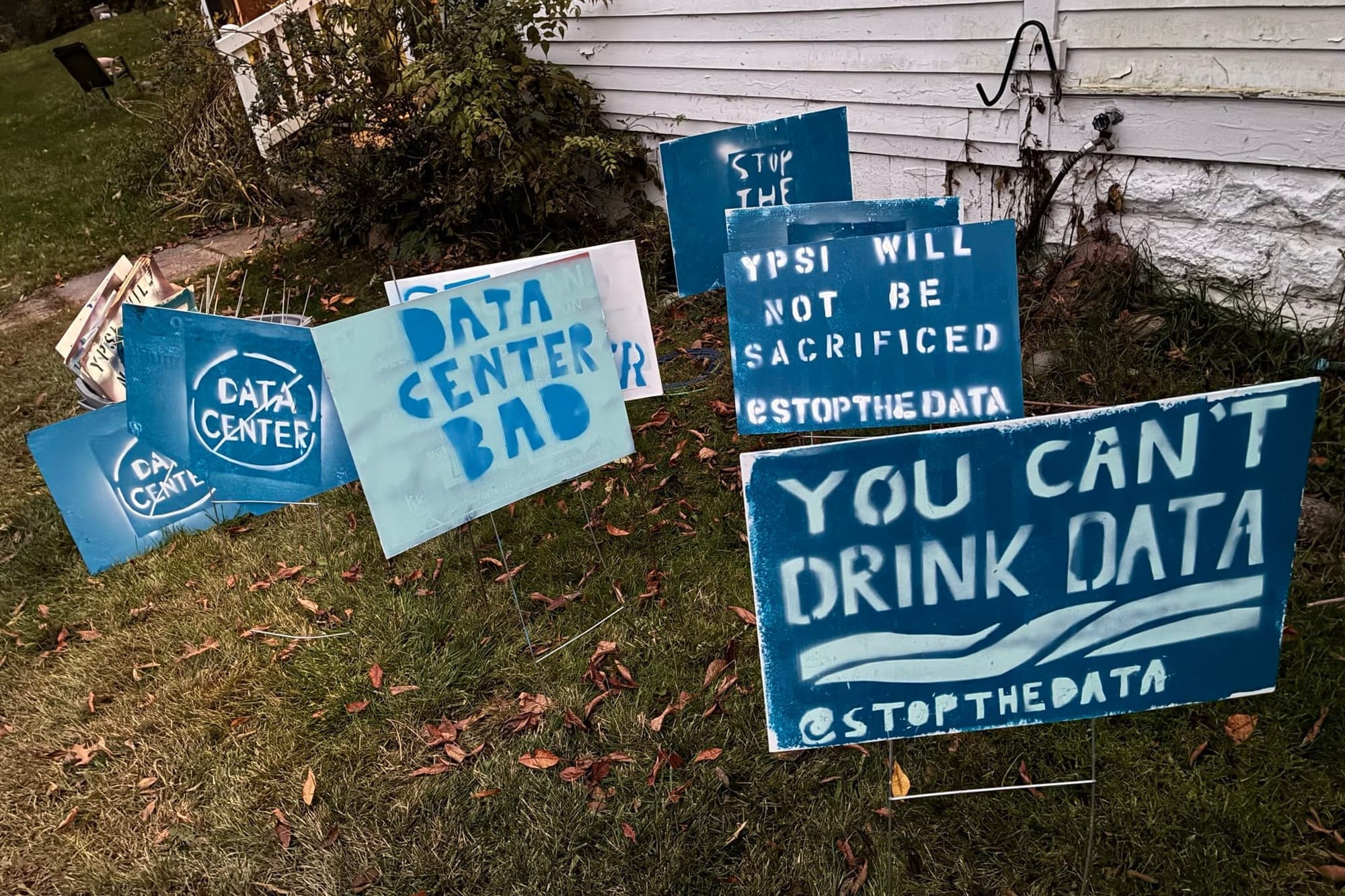
The tiny city of Ypsilanti, Michigan, is worried about being a target for drone strikes thanks to a planned datacenter that the University of Michigan is building to support nuclear weapons research According to Douglas Winters, the city’s attorney, the University and Los Alamos National Laboratories (LANL) “have put a big bulls eye target on this entire township […] I believe it’s the truth.”
Winters delivered a report to the town’s Board of Trustees about the proposed datacenter during a public meeting on Tuesday. “Los Alamos, which produces the nuclear weapons, is a high value target,” he said. He pointed to America’s war in Iran as proof that the datacenter would be a target, noting that Iran’s drones had disabled AWS servers in the Middle East. “This is not a commercial datacenter. A Los Alamos datacenter is going to be the brains of the operation for nuclear modeling, nuclear weaponry.”
The university and LANL first announced their plan to build a $1.25 billion datacenter in 2024. The university picked nearby Ypsilanti—population of about 20,000—as the location for the datacenter and residents have been fighting it ever since. Concerns from the community are typical for people fighting against a datacenter: water, rising electricity bills, pollution, and noise.
Unique to the Ypsilanti datacenter fight, however, is its role in the production of nuclear weapons. The datacenter would service LANL, the birthplace of the atomic bomb and home to America’s nuclear weapons scientists. In January, LANL confirmed that the datacenter would, indeed, be used in nuclear weapons research.
To hear the university tell it, the datacenter will be one of the most advanced computing systems in the world. “We were told at the very beginning by U of M’s Vice President of public relations […] that they were going to build, in his words, the biggest, baddest, fastest computers in the world,” Winters said at the public meeting. “That, in of itself, is what makes these datacenters high value targets […] these data centers constitute power. Artificial intelligence is power. Supercomputers are power. And when something becomes that important, it becomes a target.”
Winters questioned the American military’s ability to protect targets from the threat of drone attacks on its own soil. “The drone capability is not a joke, folks,” he said. “The United States and Israel, in spite of all their high technology they’re bringing to bear in their war on Iran, they’ve actually had to request that Ukraine send their top advisors to help them understand how to best detect and destroy these drone attacks.”
He also questioned U of M’s values. Following a demand from the White House, the university eliminated its DEI programs in 2025. In February, again at the behest of the federal government, it announced the end of the PhD Project which helped people from underrepresented backgrounds get PhDs. “You have a situation now where the University of Michigan […] has cut a deal with the Department of War under Trump,” Winters said. “That’s what the University of Michigan has turned into by basically selling their soul to the Department of War.”
Jay Coghlan, the executive director of Nuclear Watch New Mexico, told 404 Media, “That LANL datacenter is going to be the brains for nuclear modeling and nuclear weaponry. Ultimately that’s what it’s all about. Beware, a recent study found that in war games artificial intelligence went to escalation and nuclear war 95 percent of the time.”
According to Coghlan, the construction of the datacenter followed a familiar pattern. “The Lab has colonized brown people for eight decades here just like it’s now trying to do in Ypsilanti (New Mexico is 50 percent Hispanic and 12 percent Native American). But what the brown people in Ypsilanti have that they don’t have here is lots of water,” he told 404 Media.
Another topic of discussion at the Tuesday meeting was how to stop the construction of the datacenter. Winters and others explained that it’s been difficult to get the university, county, and other government powers to engage with them. Interested parties plead ignorance or recuse themselves because of financial involvement with U of M. “They’ve acted like The Godfather, making you an offer that you can’t refuse,” Winters said.
Trustee Karen Lovejoy Roe questioned why LANL wanted to build a datacenter 1,500 miles away from its home. “Why don’t you do that datacenter where you’re going to build the plutonium pits? One’s in South Carolina, one’s in New Mexico. Tell me why?” Roe said during the meeting. “They thought that we would be an easy target […] that we’re just a bunch of poor brown and black and dumb hillbillies.”
But the Township isn’t completely powerless. “U of M is totally above the law, but is DTE?” Sarah, an Ypsilanti resident said during public comments. DTE is the local power company. Datacenters are electricity hungry buildings and DTE will need to build substations to service LANL’s supercomputers.
“What if we had a moratorium on substations until we learned about the harmonics of the electricity and how that’s impacted by datacenters?” Sarah said. “Having a moratorium on heavy construction on the roads, you know, heavy construction equipment on the roads leading to the datacenter site […] it’s going to be scary and hard to stand up to the University of Michigan. It’s true: they’re very powerful and we just need to be creative and we need to be strong and we need to block them at every step of the way.”
Holly, another resident, suggested another plan of attack. “U of M’s vulnerability is in their reputation,” Holly said. “We need to continue to make them look as bad as possible.”