
An AI-powered tool designed to target trademark violations on social media was used to silence critics of SXSW, the massive annual tech, music and film conference in Austin, Texas.
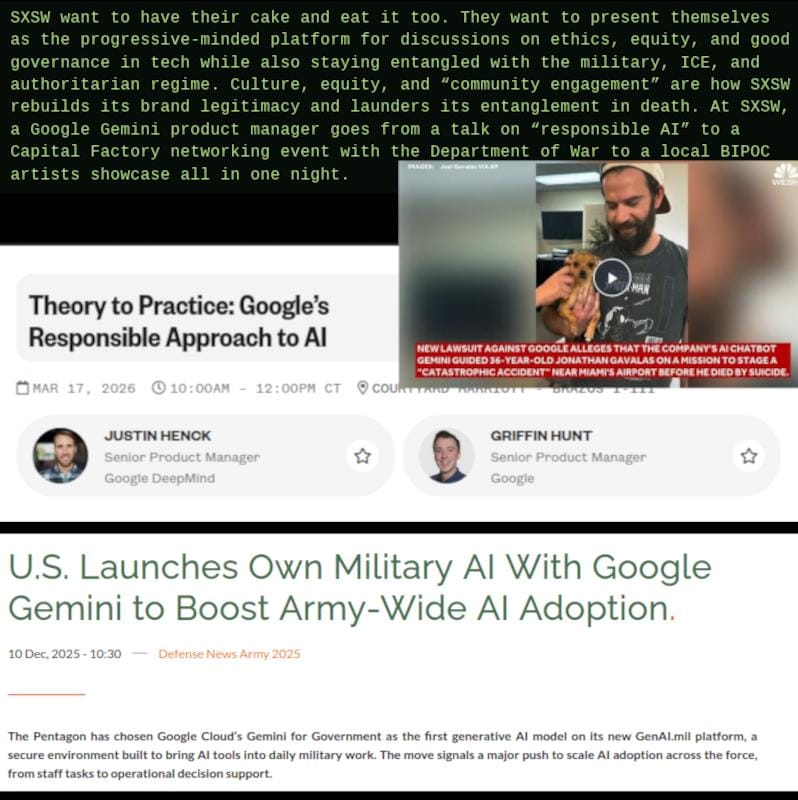
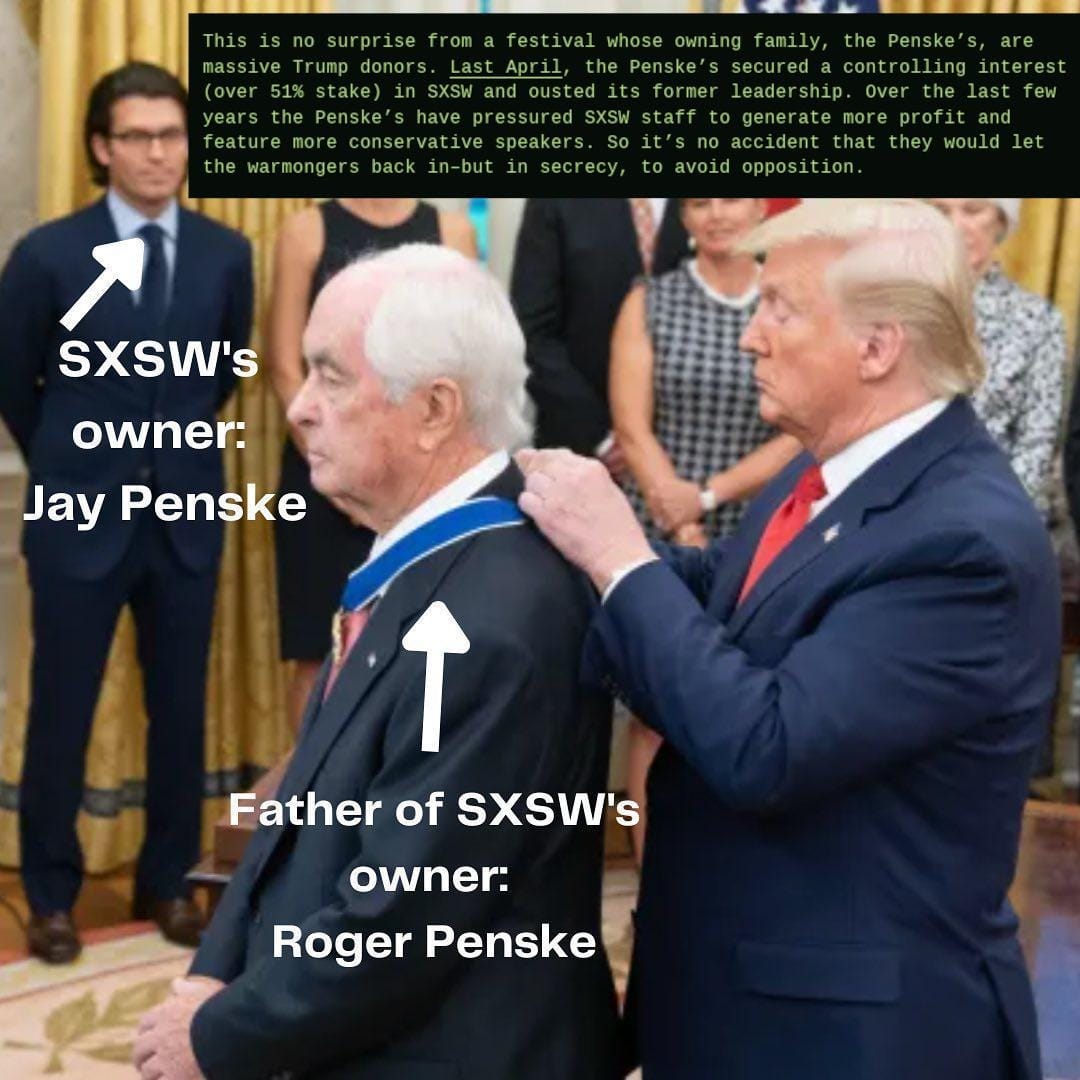
Each year in March, SXSW takes over Austin. This year, thanks to the demolition of the city’s aging convention center, events sprawled to more locations than usual, from hotel ballrooms to vacant lots. But the character of SXSW has changed, growing more corporate and less accessible since its relatively humble origins in 1987, and today it has numerous detractors. This year some of those dissenting voices found themselves targeted by BrandShield, a “digital risk protection” service that claims to use artificial intelligence to automate the process of identifying and removing social posts that misuse trademarks.
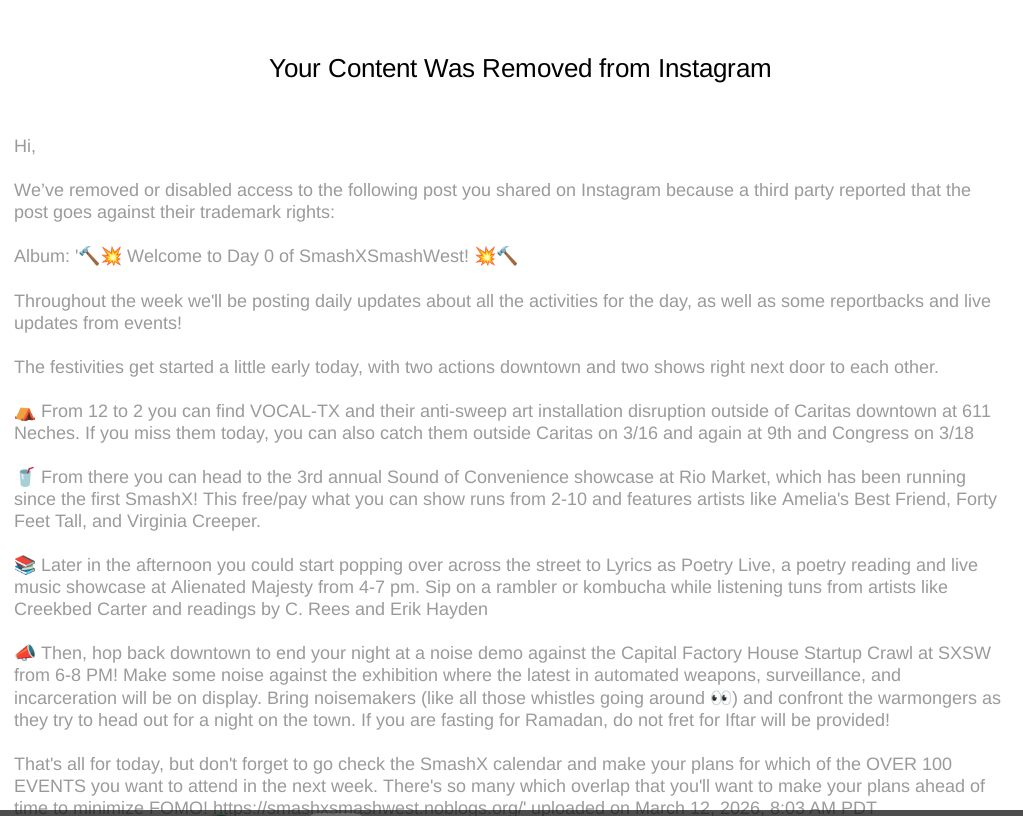
Among the groups to receive a social media takedown notice was Vocal Texas, a nonprofit dedicated to ending homelessness, HIV, poverty and the war on drugs. On March 12, members of the group set up a mock encampment in downtown Austin, to draw attention to the possessions that unhoused people can lose during “sweeps,” when police and city officials clear out and destroy or confiscate their tents and other lifesaving supplies.
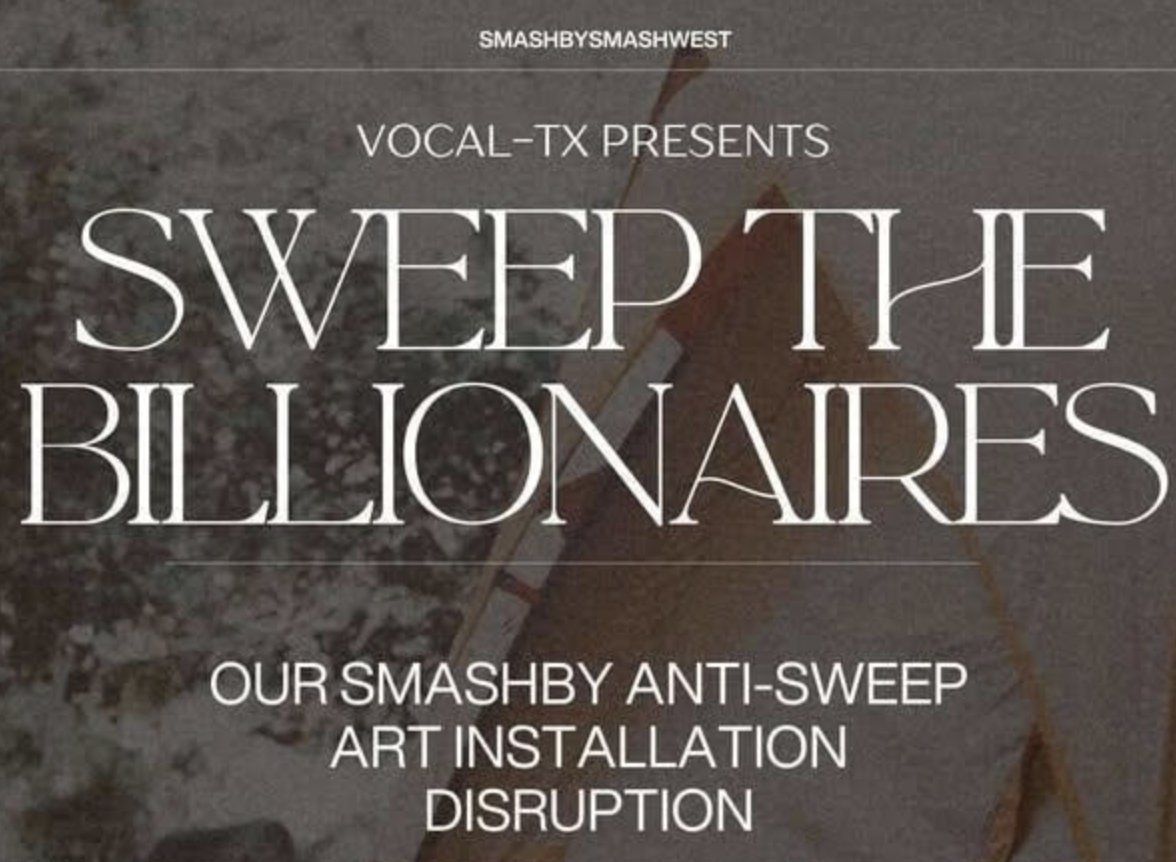
An Instagram post by Vocal Texas read, “SXSW means unhoused Austinites in downtown face encampment sweeps, tickets and arrests while the City makes room for billionaires and corporations to rake in profits.” The accompanying image promised an art installation called “Sweep the Billionaires,” and does not use SXSW’s logos.
Even so, the mere mention of SXSW was apparently enough to flag BrandShield’s trademark detection service, resulting in the post’s fully automated removal from Instagram. Cara Gagliano, a senior staff attorney who specializes in trademark and intellectual property law at the Electronic Frontier Foundation said that posts like these do not violate SXSW’s trademark.
“You’re allowed to use a company’s name to talk about the company, right?” Gagliano told 404 Media. “How else are you going to do it?”
Gagliano noted that trademark law has specific carveouts for exactly this kind of critical speech. “Examples like that, where it’s not (for example) advertising a concert with a name similar to South by Southwest … are pretty clearly over-enforcement,” she said.
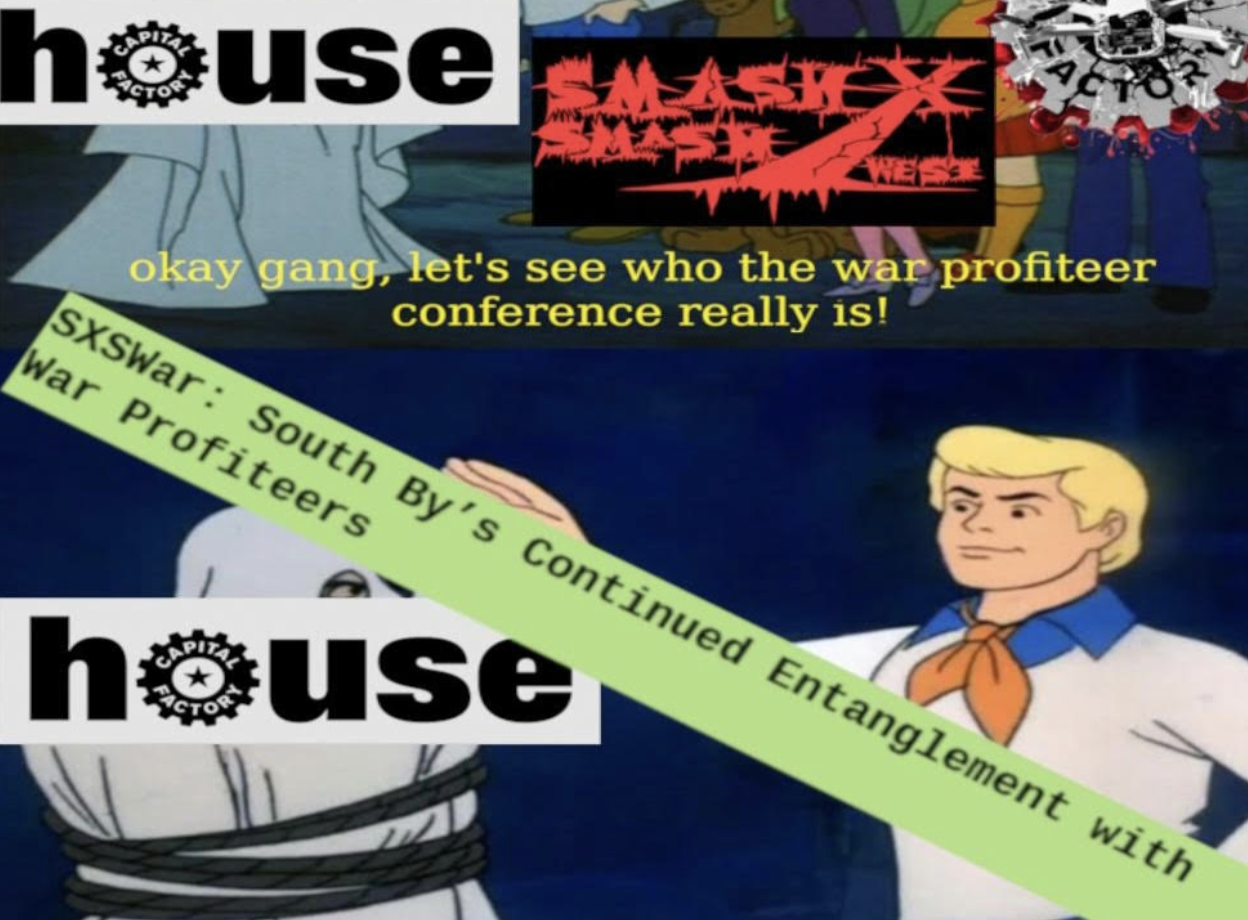
EFF interceded in March 2024 when the Austin for Palestine coalition received a cease and desist letter from SXSW, accusing them of infringing on the conference’s trademark and copyright. The coalition, which was involved with organizing successful protests against the festival’s sponsorship by the U.S. military, had made social media posts featuring SXSW’s trademarked arrow logo reimagined with bloodstains, fighter jets, and other warlike imagery. The EFF wrote a letter on the coalition’s behalf, and the group never heard from SXSW again.
But Gagliano explained that this situation is different from the takedown notices sent by BrandShield. “When it’s a threat sent to … the person who made the allegedly infringing use, them going away is a victory for the client because nothing bad happens to them, but when you have these takedowns … [while] it’s good that they didn’t go even further and file a lawsuit, they also don’t have any incentive to retract the complaint, and so the content stays down.”
This year, many of the protests and “counter events” were organized by a very loosely associated coalition of groups called Smash By Smash West, which included Vocal Texas along with many others, from musicians and independent movie directors to event venues.
404 Media reached a representative of Smash By Smash West via Signal who used the name “Burnice.” We agreed to protect their anonymity, but verified that they were involved with the organizing of Smash By events. Operating since 2024, Smash By has no leaders and essentially anyone can organize an event under its umbrella. This year, there were over 100 events, according to Burnice. “It is a decentralized call to action and a platform that enables promotion and connecting together all of these different events.”
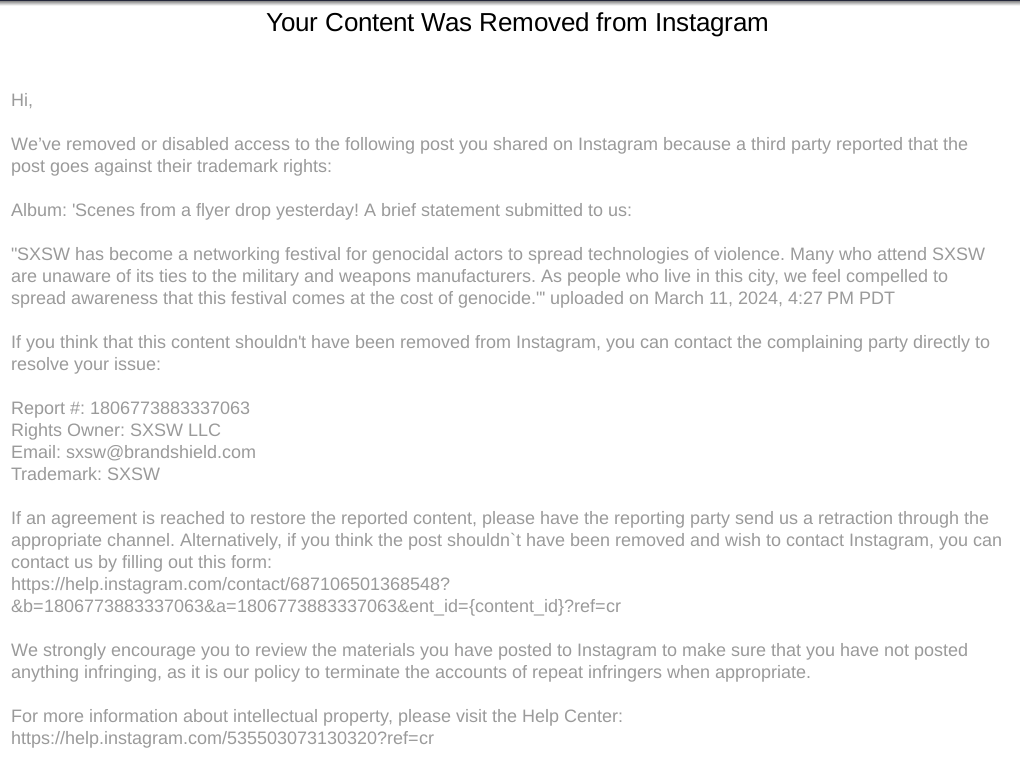
Smash By Smash West provided us with dozens of screenshots of Instagram takedown notices as well as many of the posts which had been removed.
BrandShield’s software enables mass reporting of potentially infringing content, with reports in turn evaluated by Instagram’s automated moderation systems. Despite their obviously automated nature, BrandShield claims to use a “dedicated enforcement team of IP lawyers” to ensure that takedowns are “timely, targeted and fully compliant.”
The BrandShield website reads, “Whether it’s a distorted logo, a counterfeit image, or a cloned storefront, our proprietary image recognition technology scans marketplaces, social media, paid media, and mobile environments to catch threats at the source.”
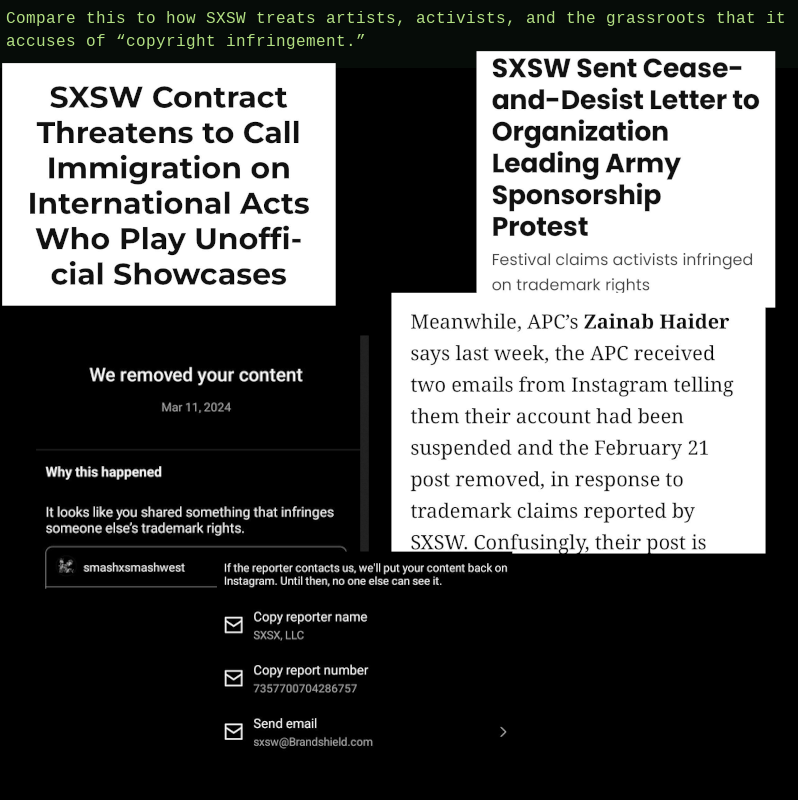
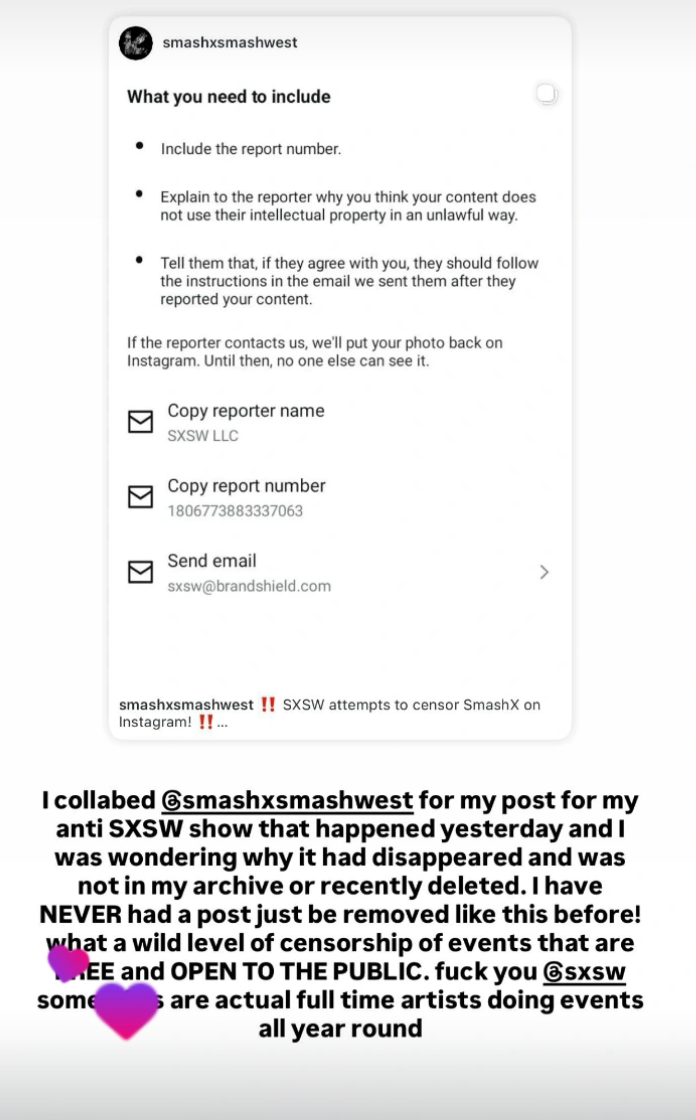
However, despite these assurances, it seems clear that BrandShield’s trademark targets with a very broad brush, and seems incapable of distinguishing between trademark violations and protected free speech. Although BrandShield initially connected us with their public relations department, they did not respond to repeated requests for comment including an emailed list of inquiries.
Instagram’s automatically generated takedown notices include the sentence, “If you think this content shouldn’t have been removed from Instagram, you can contact the complaining party directly to resolve your issue.” However, there is a link allowing the recipient to appeal the takedown, which then leaves it up to Instagram moderators’ discretion if it returns.
Gagliano explained that this is a crucial area where trademark differs from copyright law. Thanks to the Digital Millenium Copyright Act (DMCA), there’s a clear (though often arduous) path to contesting false claims of copyright violations which allows content creators to get their posts put back. There’s no similar, mandatory pathway written into trademark law. “There’s no counter notice process where they say, ‘Okay, you told us this is fair use, so we’ll put it back up.’ And that’s a really frustrating thing,” Gagliano said.
Mathew Zuniga, who does most of the booking for Tiny Sounds Collective, an organization that throws free DIY music shows and publishes zines, said he struggled with the process offered by Instagram after a post about a Tiny Sounds’ Smash By concert was taken down.
“I tried to do it,” he said. “It didn’t really go through.“
When he reposted the same image and text, but without tagging Smash By Smash West’s Instagram account as a collaborator, the post remained online.
“I think it’s silly, as if these DIY shows in a bookstore are pulling anyone away from South By,” Zuniga said. “I think it was more of a deliberate attempt to take down anti-South By Southwest rhetoric online.”
When reached for comment, SXSW’s PR team sent back a prepared statement, noting that the law requires them to “take reasonable steps” to enforce their trademarks.
“SXSW’s efforts are not intended to limit commentary, criticism, or independent reporting, and we respect the importance of free expression,” the spokesperson’s statement continued. “We use third-party services, including BrandShield, to help identify potential issues at scale, and we recognize that errors can occur.”
By contrast, Burnice explained that, rather than trying to steal SXSW’s trademark, Smash By Smash West makes it a condition that participants can’t describe their events as free or alternative SXSW events. “Smash By … was an attempt to politicize the DIY scene, the ‘unofficial’ South By shows, and make them explicitly anti-South By.”
Smash By provides alternative logos, some of which are wholly unique but others based on parodying or “detournements” of the SXSW logo, similar to what the Austin for Palestine coalition did in 2024. Burnice expressed their frustration with the automated nature of the quashing of dissent this year.
“All of that is actually just happening by robots talking to robots,” they said. “It’s an AI system that mass reports these accounts, and then, you know, probably an AI system at Instagram that just sorts through, and approves or rejects.”
For her part, Gagliano expressed skepticism over whether artificial intelligence plays a major or important role at companies like BrandShield beyond just its current popularity as a tech buzzword. ”I haven’t seen any kind of change in the volume of requests for help that we’re getting, and this is one thing where I’m a little skeptical that it’s really made much difference, because they were already using automated tools before, and I think in any instance, the tools are not going to be able to reliably determine what’s actually infringement.”