
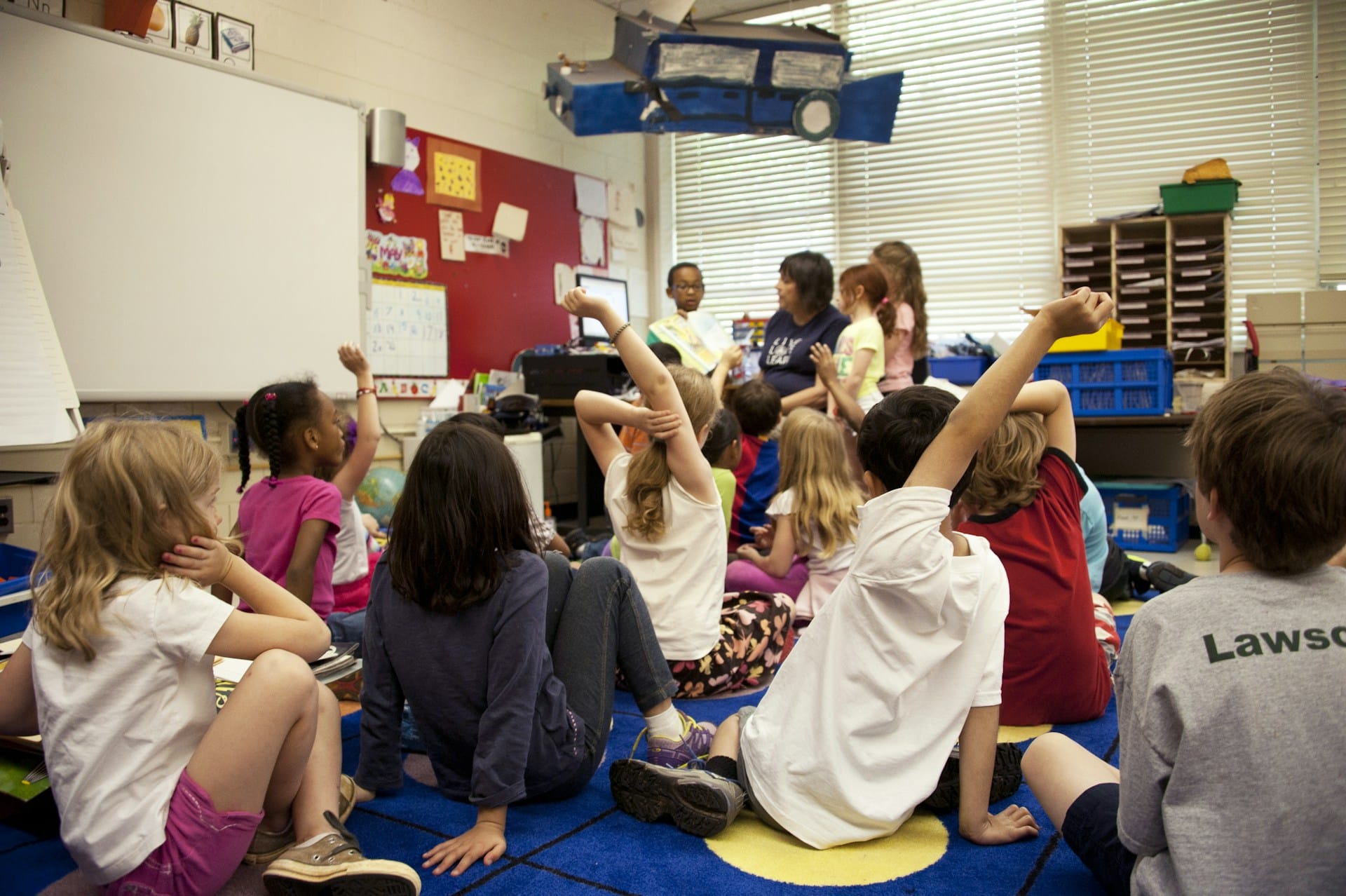
University of Washington researchers planned to have preschool teachers wear cameras that would record everything they saw from a first-person perspective, including the children they were teaching, then use that footage to develop AI models. Crucially, the program was presented as opt-out, rather than opt-in, meaning that parents had to take steps to prevent recordings of their children being processed by AI.
“With your permission, your child’s lead teacher may wear a small teacher-worn camera that captures the teacher’s approximate first-person perspective, and/or we may place a fixed video camera in the classroom,” a document given to parents and later shared with 404 Media reads. “These videos simply capture the normal interactions between teachers and children during regular classroom activities. Recordings occur during morning program hours up to 150 minutes, up to 4 visits in one month. Your child will not be asked to do anything new or different. Their daily routine will stay exactly the same.”
404 Media has repeatedly covered how AI is permeating through education. That includes students using AI themselves, and even the creation of entire AI-powered schools. Now, the University of Washington research shows how AI data collection is pushing into early childhood education too.
Or, it would have, if parents didn’t revolt. After a backlash, the University of Washington told 404 Media it has now shelved the planned research.
“The goal of this study is to better understand children’s everyday learning experiences and to develop Al tools that can help assess classroom interaction quality,” the document says. The research was being led by Dr. Gail Joseph and the Cultivate Learning team at the University of Washington, it says. Joseph’s work focuses on early childhood education.
The document says that this collected footage would have been used to “develop and evaluate AI models for assessing classroom interaction quality.” That includes human reviewers watching and annotating the videos, with that data then improving AI models. “AI tools will also analyze the same recordings to generate codes and justifications,” the document reads. The document doesn’t name any specific AI providers, but says, “Video data may be processed using cloud-based AI services.”
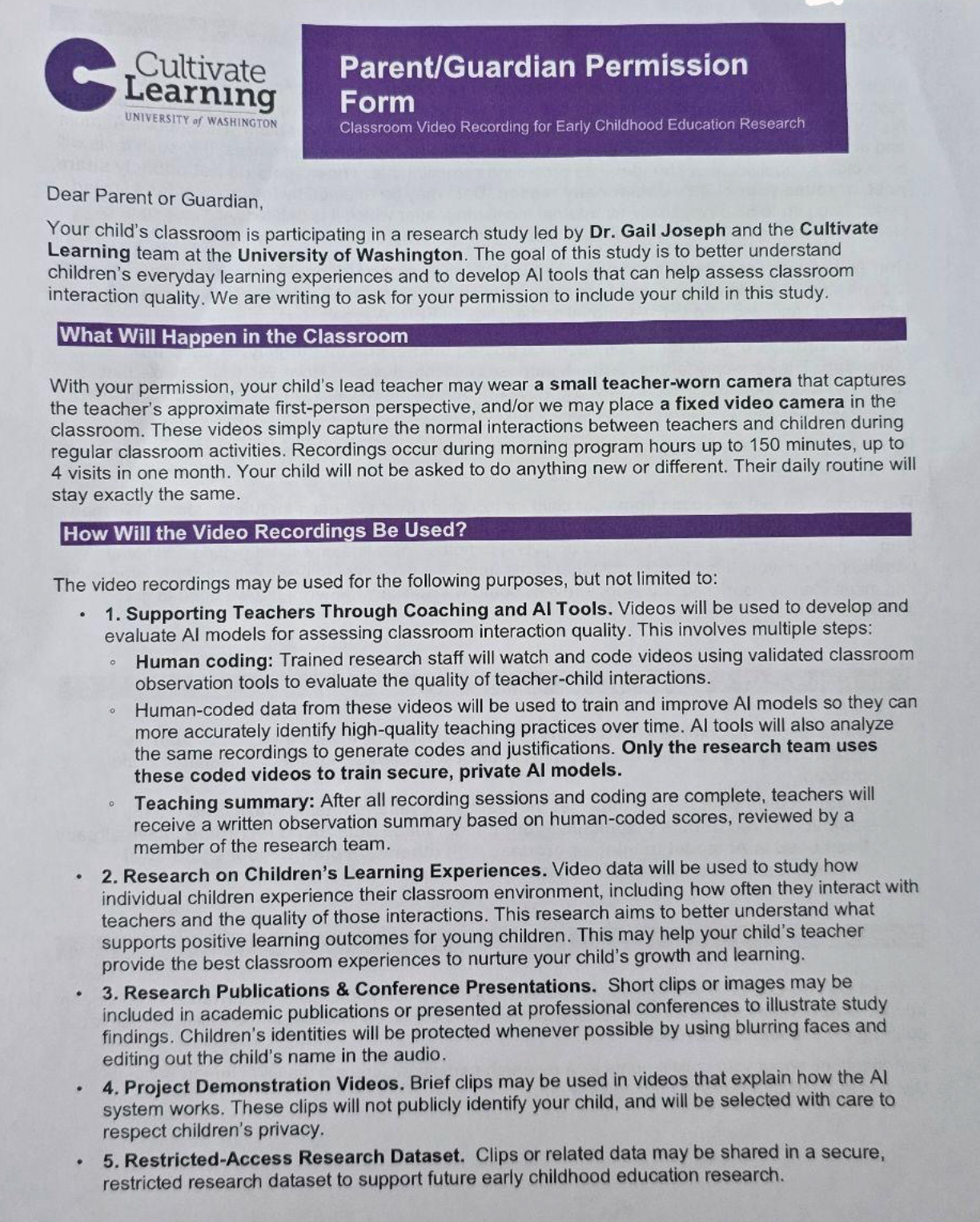
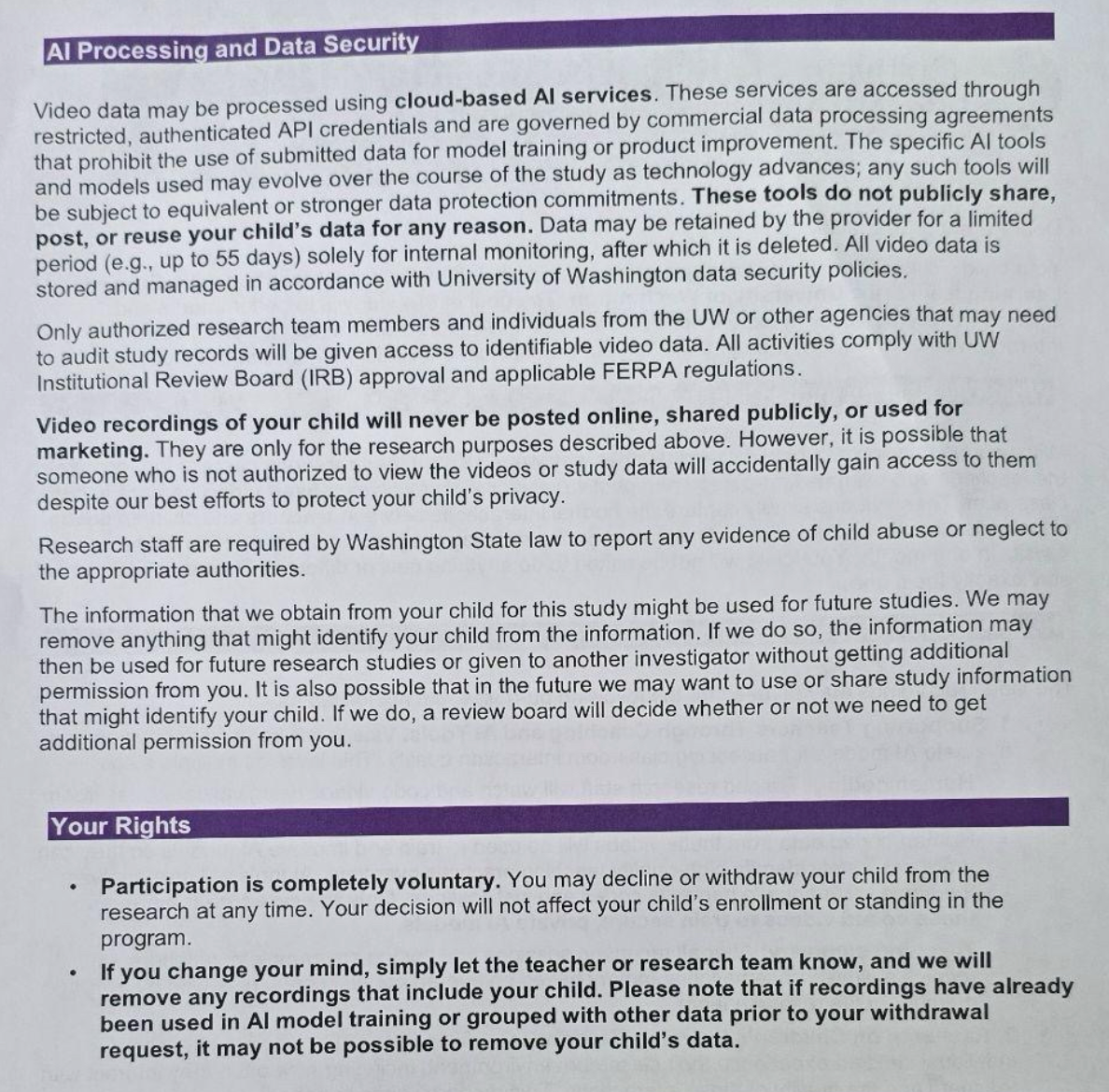
Photos of the notice given to parents. Image: 404 Media.
Only the research teams would have used the annotated videos to train “secure, private AI models.”
Teachers were to be given a “written observation summary,” it adds. The researchers say the footage and audio may have been used in academic papers or for conferences, but the researchers planned to blur faces and edit out names “whenever possible.”
Finally, the collected footage and data may be shared with others “to support future early childhood education research,” the document says.
A parent who received the document said they were “taken aback” after reading it. “I am troubled by the idea of using my child’s likeness in unknown AI tools and how this could be abused,” she added. “I was particularly concerned about families’ ability to give informed consent. As a native English speaker, the vague language in the handout left me with a slew of questions. Many families in our school are migrants and non-native English speakers, but forms were not provided in any of their native languages.” 404 Media granted the parent anonymity to avoid repercussions.
404 Media sent sections of the document to multiple experts in education and AI. “The excerpt doesn’t provide important information, and those omissions concern me (assuming they’re not provided in another part of the letter I haven’t seen). Who may the data may be shared with? How long will it be maintained? Who is funding the research? Those are questions that I would want answers to, and the answers could exist,” Faith Boninger, co-director of the National Education Policy Center, told 404 Media. “A big question that doesn’t have an answer relates to the language that describes the purposes for which the videos may be used. The wording ‘not limited to’ implies that there could be any number of future uses to which the data may be put that haven’t even been thought of yet.”
“I am always hopeful we will continue to find ways to improve support for teachers and students. While I don’t know the details of this specific study, from what you shared, I am glad to see research that includes humans in the loop and clear disclosure of data collection and use,” Jake Baskin, executive director of the Computer Science Teachers Association, told 404 Media. “That said, anytime we bring cameras and AI into the classroom, protecting student and teacher data must be the highest priority. Rigorous research with transparent publication of results is how we will learn what actually helps educators in the classroom.”
The document presents participation in the research as “completely voluntary.” But it is not an opt-in model. Instead, parents have to opt-out if they don’t want their children to be recorded by a teacher-worn camera and have that footage processed by AI. “You may decline or withdraw your child from the research at any time. Your decision will not affect your child’s enrollment or standing in the program,” it says.
That raised questions around how that would practically work. If one parent opted their child out, would only they be omitted from any footage? Jackson Holtz, assistant director of University of Washington News, told 404 Media in an email that if a parent did opt-out, that entire class would be removed from the research. “The consent process was designed so that not only could families opt out, if even a single family decided to opt out, their entire classroom would be excluded,” he wrote. The parent said, “Only through questioning teachers and school administrators did we learn the researchers would put stickers on children who opted out, but no further information was provided on whether they would still be filmed.”
“Our initial outreach was intended to help us better understand how families would feel about a project that uses artificial intelligence to support teachers,” Holtz continued. Holtz said after that feedback, the University of Washington has stopped the research. “Given the early responses from parents, we have terminated the study and are no longer seeking participation at any site. (It is not unusual to terminate a study in the early stages as we receive feedback from community partners.) All programs are in the process of being notified that this particular study is now terminated,” he wrote.
After 404 Media contacted the university for comment, the section of its website describing the study was taken offline.