
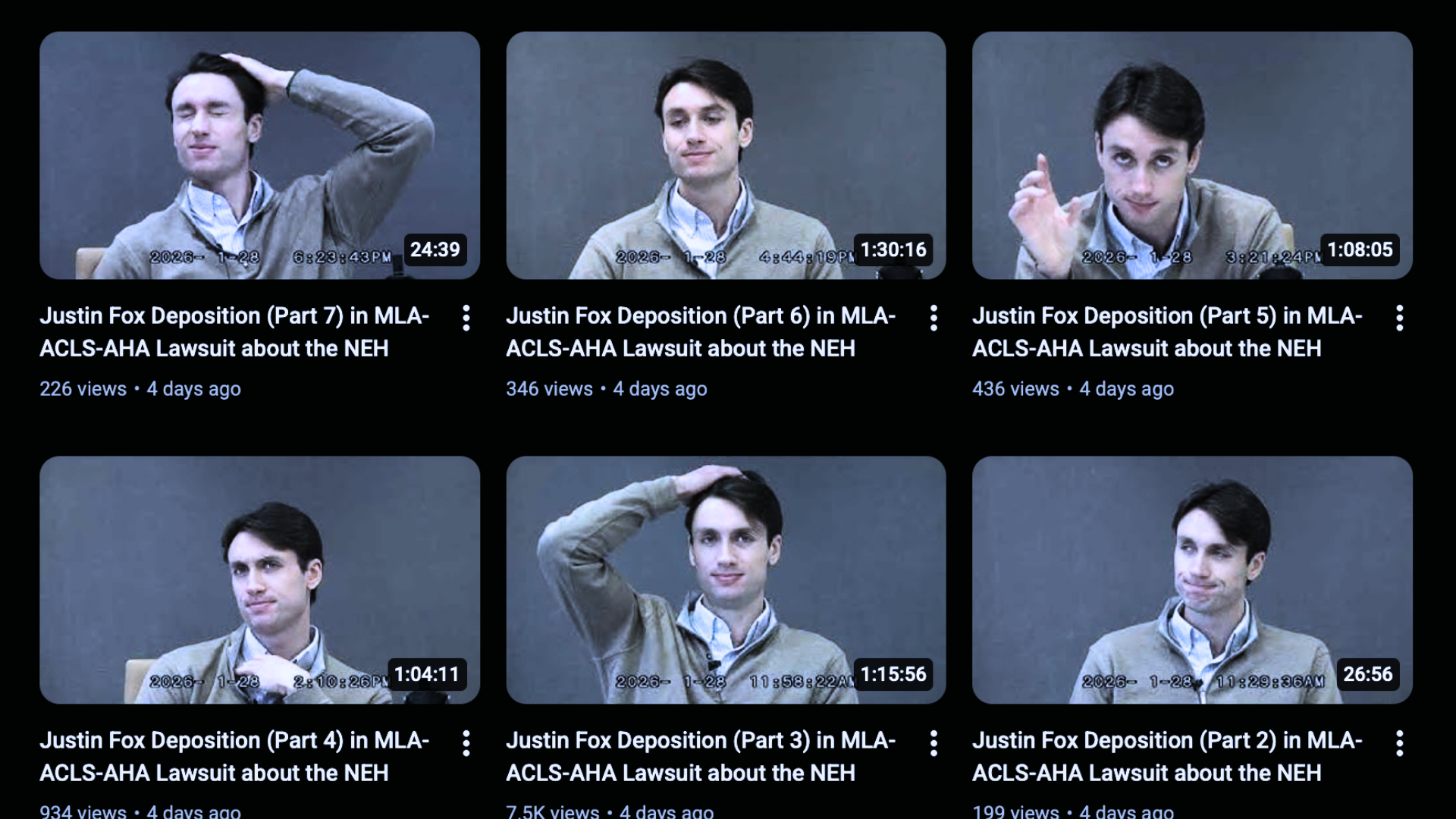
On Monday a judge said videos of recent depositions from DOGE members can be published online once again. The ruling is something of an about face for Judge Colleen McMahon, who originally ordered plaintiffs in the DOGE-related lawsuit “claw back” the videos they had published to YouTube. The videos were already massively viral at the time of that ruling, in part because they showed DOGE members Justin Fox and Nate Cavanaugh unable or unwilling to define DEI, admitting their use of ChatGPT to filter contracts to potentially axe based on words like “Black” and “homosexual” but not “white,” and were broadly one of the first times the public has directly heard from people inside DOGE.
“This decision validates our position that the publication of the videos, which document a process to destroy knowledge and access to vital public programs, was indeed in the public’s interest,” Joy Connolly, president of the American Council of Learned Societies, said in a statement shared with 404 Media. “We look forward to continuing the pursuit of justice in reclaiming government support for important humanities research, education, and sustainability initiatives.”
The American Council of Learned Societies is one of the plaintiffs in the lawsuit, along with the American Historical Association and the Modern Language Association. The organizations are suing Fox, Cavanaugh, the National Endowment for the Humanities (NEH) and others for their role in cutting hundreds of millions of dollars worth of contracts they perceived as being DEI-related.
In her ruling McMahon wrote, “[T]he testimony in the videos concerns the conduct of public officials acting in their official capacities—a context in which the public interest in transparency and accountability is at its apex [. . .] The subject matter of this testimony—how government officials carried out their official responsibilities—falls squarely within that core public interest.”
Sarah Weicksel, executive director of the American Historical Association, added in the joint statement, “We are pleased that this evidence, which documents the workings of DOGE and the dismantling of the National Endowment for the Humanities, will remain part of the publicly accessible historical record.”
Paula Krebs, executive director of the Modern Language Association, said, “We are pleased to see today’s ruling in defense of the First Amendment rights of all Americans.” The statement added, “The depositions in this case document what had not before been documented: how DOGE worked to silence projects that tell the American story. This ruling makes clear the public’s stake in understanding the processes that resulted in the near-destruction of the NEH.”
The Modern Language Association uploaded the DOGE depositions to its YouTube channel earlier this month. They quickly went viral after 404 Media and other media outlets clipped segments of the hours of material, including one section in which Fox could not, or would not, define DEI. I personally watched the entire 6 hours of Fox’s deposition, and parts of Cavanaugh’s. The uploaded depositions also include those from NEH officials Adam Wolfson and Michael McDonald.
After that coverage, which the government explicitly referenced in a court filing, the government asked the judge to intervene because it said Fox had received death threats, and that the videos could cause harassment and “reputational harm.” The judge ordered the plaintiffs to “immediately take any and all possible steps to claw back the videos of the depositions of the witnesses identified in the Government’s motion.”
At that point, the depositions were no longer available on the plaintiffs’ YouTube channel. But as 404 Media reported, archivists quickly uploaded copies to the Internet Archive and distributed them as a torrent.
At the time of writing, the videos are available on the YouTube channels of the American Historical Association and the American Council of Learned Societies.