
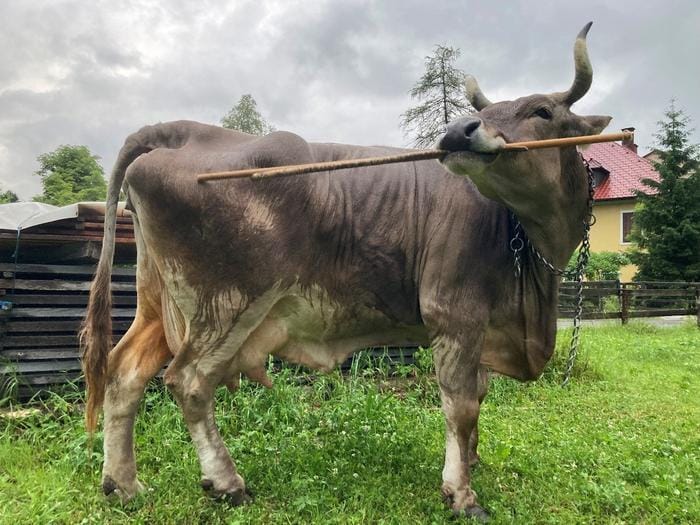
Welcome back to the Abstract! Here are the studies this week that scratched the sweet spot, extended a hand, went over the hill, and ended up on Mercury.
First, a clever cow single-hoofedly upends assumptions about bovine intelligence. Next, we’ve got the oldest rock art ever discovered, the graying of modern zoos, and the delightfully named phenomena of bursty bulk flows.
As always, for more of my work, check out my book First Contact: The Story of Our Obsession with Aliens or subscribe to my personal newsletter the BeX Files.
Cows use tools? You herd it here first
Osuna-Mascaró, Antonio J. et al. “Flexible use of a multi-purpose tool by a cow.” Current Biology.
Veronika, a Swiss brown cow that lives in a rural mountain village in Austria, is the first cow to demonstrate tool use. How udderly amoosing!
Veronkia’s owner Witgar Wiegele, who keeps her as a pet companion, noticed years ago that she likes to pick up sticks with her mouth in order to reach hard-to-scratch places on her body.
The hills were soon alive with word of Veronika’s tool-using prowess, attracting the attention of researchers Antonio Osuna-Mascaró and Alice Auersperg of the University of Veterinary Medicine Vienna.
Tool use is a sign of advanced cognition that has been observed in many animals, including primates, orcas, and birds. But cows, with their vacant expressions and docile nature, have been overlooked as likely tool users, except as a joke in Gary Larson’s Far Side cartoons.
In their new study, Osuna-Mascaró and Auersperg presented Veronika with a deck brush, which she proceeded to use as a scratching tool in a variety of configurations.
“We hypothesized that she would target difficult-to-reach body regions and use the more effective brushed end over the stick end,” the researchers said. “Veronika’s behavior went beyond these predictions, however, showing versatility, anticipation, and fine motor targeting.”
“Unexpectedly and revealingly, Veronika’s tool-end use depended strongly on body region: she predominantly used the brush end for upper-body scratching and the stick end for lower areas, such as the udder and belly skin flaps,” they added. “Importantly, the differential use of both broom ends constitutes the use of a multipurpose tool, exploiting distinct properties of a single object for different functions. Comparable behavior has only been consistently documented in chimpanzees.”
I recommend reading the study in full, as it is not very long and contains ample video footage demonstrating Veronika’s mastery of the deck brush. The authors seem genuinely enraptured by her talents and, frankly, it’s hard to blame them for milking the discovery. Overall, the findings serves as a reminder not to cowtow to stereotypes of braindead bovines, a point made by the study’s bullish conclusion:
“Despite millennia of domestication for productivity, livestock have been almost entirely excluded from discussions of animal intelligence,” Osuna-Mascaró and Auersperg said. “Veronika’s case challenges this neglect, revealing that technical problem-solving is not confined to large-brained species with manipulative hands or beaks.”
“She did not fashion tools like the cow in Gary Larson’s cartoon, but she selected, adjusted, and used one with notable dexterity and flexibility,” they concluded. “Perhaps the real absurdity lies not in imagining a tool-using cow, but in assuming such a thing could never exist.”
Now that’s something to ruminate on.
In other news…
Hands of ancients
Archaeologists have discovered the oldest known rock art, which are very faint hand stencils made by humans 68,000 years ago on a cave wall on the Indonesian island of Sulawesi.
For comparison, the next oldest rock art, located in Spain and attributed to Neanderthals, is roughly 66,000 years old. The newly-dated hand stencils were made by a mysterious group of people who eventually migrated across the lost landmass of Sahul, which is now submerged, and reached Australia.
https://youtu.be/PRNL329dZ9Y?si=GB669R7KajqivlzZ
The find supports a “growing view that Sulawesi was host to a vibrant and longstanding artistic culture,” said researchers co-led by Adhi Agus Oktaviana and Budianto Hakim of Indonesia’s National Agency for Research and Innovation, and Renaud Joannes-Boyau of Southern Cross University.
“The presence of this extremely old art in Sulawesi suggests that the initial peopling of Sahul about 65,000 years involved maritime journeys between Borneo and Papua, a region that remains poorly explored from an archaeological perspective,” the team added.
Though the stencils are extremely faint and obscured by younger paintings, it’s still eerie to see the contours of human hands from a long-lost era when dire wolves and Siberian unicorns still roamed our world.
Zoo animals get long in the tooth
Speaking of really old stuff, there has been much consternation of late about falling birth rates and aging populations in many nations around the world. As it turns out, similar demographic anxieties are playing out in zoos across Europe and North America, where mammal populations “have, on average, become older and less reproductively active” according to a new study.
On the one hand, this is good news because it signals improvements in the health and longevity of mammals in zoos, reflecting a long-term effort to transform zoos into conservation hubs as opposed to sites of spectacle. But it also “fundamentally jeopardizes the long-term capacity of zoos to harbor insurance populations, facilitate reintroductions of threatened species, and simply maintain a variety of self-sustaining species programs,” said researchers led by João Pedro Meireles of the University of Zurich.
This story struck me because of my many childhood visits to see an Asian elephant named Lucy, who was the star of the Edmonton Valley Zoo when I was young (I am now old). I recently learned Lucy is still chilling there at the ripe old age of 50! This is positively Methuselan for a zoo elephant, though it is not an unusual age for them in the wild. Lucy is the perfect poster child (or rather, poster senior) for this broader aging effect. Long may she reign.
Bust out the bursty bulk flow
We’ll close with a reminder that the planet Mercury exists.
It can be easy to overlook this tiny rock, which is barely bigger than the Moon. But Mercury is dynamic and full of surprises, according to a study based on close flybys of the planet by BepiColombo, a collaborative space mission between Europe and Japan, which is tasked with cracking this mercurial nut.
BepiColombo zoomed just over 100 miles above Mercury’s surface in October 2021, June 2022, and June 2023, but each encounter revealed distinct portraits of the planet’s magnetosphere, which is a magnetic bubble that surrounds some planets, including Earth.
“These flybys all passed from dusk to dawn through the nightside equatorial region but were noticeably different from each other,” said researchers led by Hayley N. Williamson of the Swedish Institute of Space Physics. “Specifically, we see energetic ions in the second and third flybys that are not there in the first.”
“We conclude that these ions are part of a phenomenon called bursty bulk flow, which also happens at Earth,” the team concluded. Bursty bulk flow, in addition to being a fun phrase to say outloud, are intense, transient jets in a magnetosphere that drive energetic particles toward the planet, and are driven by solar activity.
BepiColombo is on track to scooch into orbit around Mercury this November, where it will continue to study the planet up close for years, illuminating this world of extremes. In my hierarchy of Mercurys, the planet sits above the Ford brand, the 80th element, and the Roman god, with only Freddie surpassing it. So, it’s good to see it getting the attention it deserves.
Thanks for reading! See you next week.