
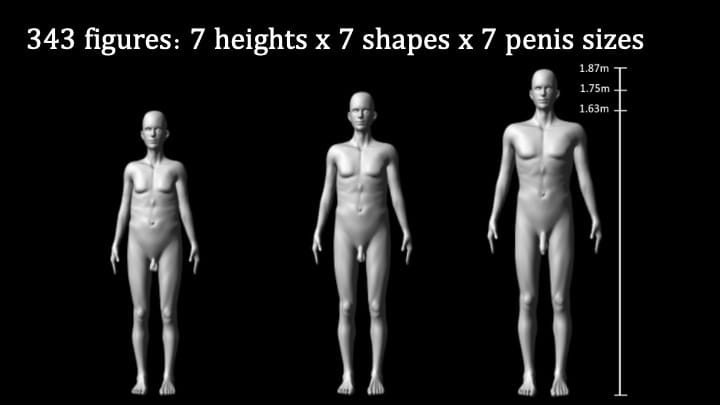
When it comes to the evolution of the human penis, size matters.
Scientists have discovered that men with larger penises are not only more attractive to women, they are also deemed more threatening to men, which is “the first experimental evidence that males assess rivals’ fighting ability and attractiveness to females based partly on a rival’s penis size,” according to a study published in PLOS Biology on Thursday.
“In humans, height and body shape are well known to influence attractiveness, but penis size has rarely been tested alongside these traits in a controlled, experimental setup,” said Upama Aich, a behavioral and evolutionary biologist at the University of Western Australia who led the study, in an email to 404 Media.
“What motivated us was the evolutionary puzzle that the human penis is unusually large relative to other primates, which raises the question of whether it signals information beyond its primary reproductive role of sperm transfer,” she added.
Sexual selection, a form of natural selection, is a process in which certain traits that enhance reproductive success—from big antlers to colorful feathers—become amplified in a lineage over time. Male traits may persist both because they are selected by females, which is known as intersexual selection, or because those traits are associated with better success against male rivals, which is called intrasexual selection.
Previous research has presented evidence that bigger penises are more attractive to women, in tandem with characteristics like height and body shape, suggesting that intersexual selection may have played a role in the anomalously large human penis. Aich and her colleagues set out to confirm that result, while also testing out the role of intrasexual selection for the first time.
The researchers recruited more than 600 male and 200 female participants to rate computer-generated male figures with different heights, body shapes, and penis sizes (all shown in a flaccid state). Some participants attended an in-person display of life-size images while others rated the figures on an online platform. Men were asked to assess the figures as potential rivals, while women were asked to rate them as potential mates.
Participants also filled out a questionnaire about their physical characteristics (including height and weight) and sexuality. Given the focus on mates and rivals, the researchers only used responses from self-identified heterosexual males and females in the study.
The team designed the approach with nondescript figures devoid of any personality or identifiable background in part to sidestep the immense cultural weight of the human penis, an anatomical feature endowed with major significance across eras and societies.
“We were very conscious that penis size is culturally loaded and surrounded by myths, humour, and anxiety,” said Aich. “That’s one reason we used anatomically accurate, computer-generated figures: it allowed us to manipulate specific traits independently while controlling for personal identity, social narratives and contextual cues.”
“I do think this cultural baggage has discouraged careful scientific study in sensitive topics in the past, but from an evolutionary perspective, that makes it even more important to examine the question empirically rather than relying on assumptions,” she added.
To that end, the new study confirmed that women generally preferred figures with larger penises in addition to taller figures with more V-shaped bodies. It also revealed for the first time that men factored penis size into their assessment of male rivals, as they rated the figures with larger penises as more threatening rivals. Even more importantly, the men overwhelmingly guessed that the figures with larger penises would be more attractive to women.
According to the researchers, this hints that in our evolutionary past, males may have avoided confrontations with rivals based in part on their penis size in addition to height and body shape. As a consequence, males with larger penises may have secured more access to mates not only due to female preference, but also because they were not challenged by rivals as often. This aspect of male-male competition may have helped to enlarge the human penis over time through selection.
“Previous research had often focused on the effect of penis size on female preferences, so our results that men also use penis size when assessing rivals adds a new dimension to the story,” Aich said. “It suggests penis size is interpreted not only in a sexual context, but also in competitive rival cues.”
“However, the effect of penis size on attractiveness was four to seven times higher than its effect as a signal of fighting ability,” she continued. “This suggests that the enlarged penis in humans may have evolved more in response to its effect as a sexual ornament to attract females than as a badge of status for males, although it does both.”
Aich said her team was most surprised by the consistency of the participants’ responses across many manipulated variables. Similar patterns in the responses showed up regardless of whether the participants were viewing life-sized projections or scaled images online, whether they received payment for the experiment, and across both male and female participants.
“One obvious next step is to study how these visual cues interact with others that matter in real-world interactions, such as facial features, voice, or movement,” she said. “Another open question is how culturally variable these perceptions are, since standards of masculinity and attractiveness differ across societies. A cross-cultural study would be interesting.”
The new study adds to the evidence that both forms of sex selection influenced the size of the human penis, but many other factors also played a role in the development of the organ. For example, penis shape and size may have evolved to scoop the sperm of rival males out of the vaginal canal, or to raise the odds of female orgasm, both of which can contribute to reproductive success.
In other words, both the size of the ship and the motion of the ocean are a part of the complex story of human sexual evolution.