
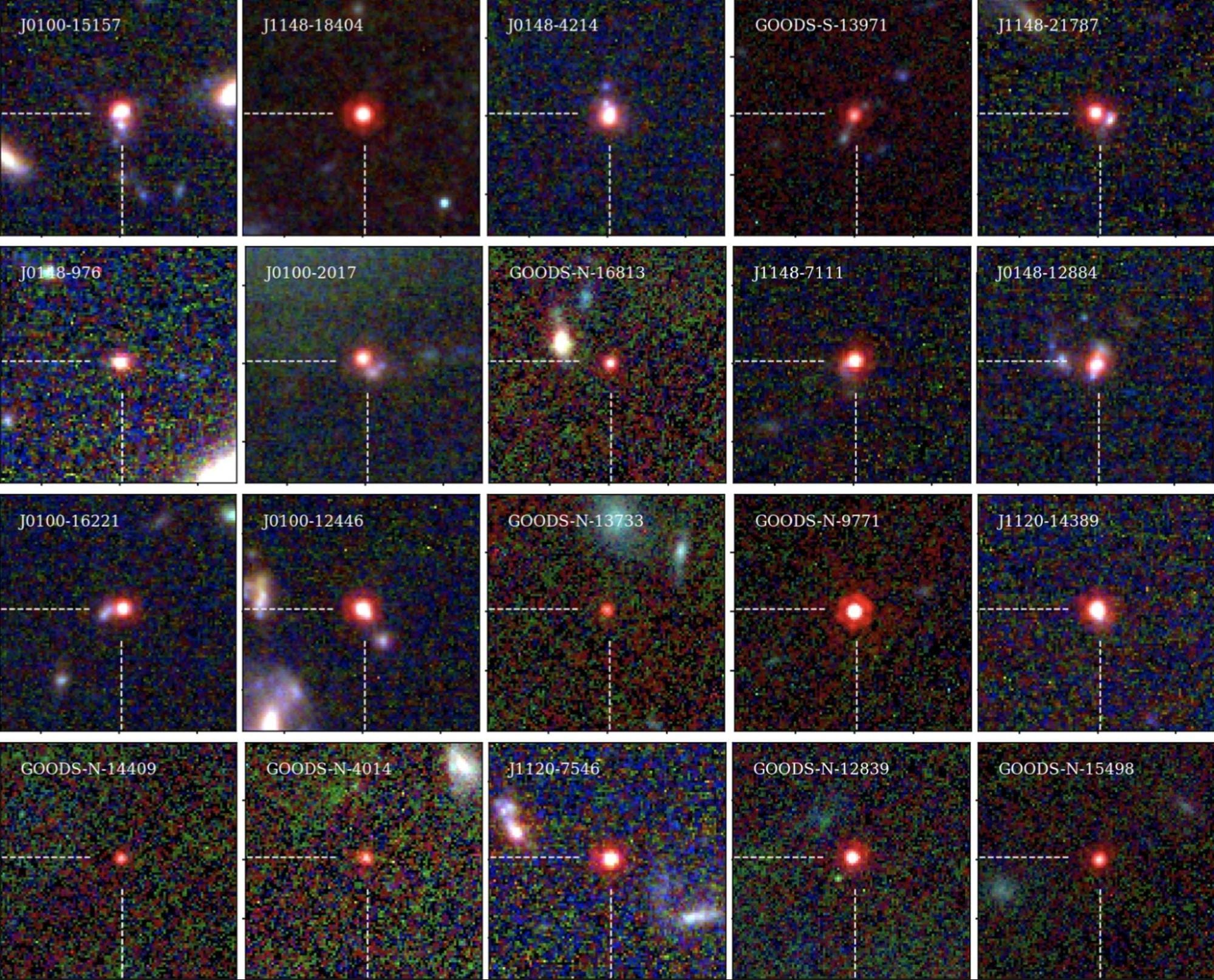
Astronomers think they have solved the puzzle of so-called “little red dots” in space, a population of bizarre objects at the very edge of the observable universe, according to a study published on Wednesday in Nature.
The new research suggests that these dots are likely the youngest black holes we have ever glimpsed, which are “cocooned” in dense gas, a never-before-seen phenomenon that sheds light on the early evolution of the universe.
“LRDs were first spotted in 2023 in the first images made with the James Webb Space Telescope,” said Vadim Rusakov, an astronomer at the University of Manchester, in an email to 404 Media. “People have very actively studied these objects since then.”
“They are tiny, bright and red objects seen when the universe was only about 5-15 percent of its current age,” he continued. “They have puzzled astronomers: on one hand, they are too compact and massive for normal galaxies, on the other, they do not look like typical supermassive black holes, because we do not detect their usual signals, such as X-rays. And they are not just a few odd apples—almost every tenth galaxy in the early universe is an LRD.”
These baffling properties have sparked spirited debate about the nature of LRDs. Some studies have suggested they might be exotic star-studded galaxies, or weirdly overmassive black holes.
Hoping to resolve the mystery, Rusakov and his colleagues analyzed JWST observations of more than a dozen of the little red dots across longer timescales. The team confirmed that the dots are likely black holes that are enshrouded by a “cocoon” of energetic gas that can explain their novel properties.
“Our simple solution is: we think that they are massive black holes wrapped in a thick cocoon of dense gas, which makes them appear red and hides the black hole,” Rusakov said. “This idea of the cocoon was inspired by another work that predicted the presence of thick gas. We could check this idea by studying the hydrogen emission from LRDs. This showed us that the cocoon is partly ionised—meaning it has lots of free electrons. This was a surprising discovery, because by scattering light, these electrons hid most useful black hole signals from our sight and also made it appear more evolved than it actually is.”
“By looking inside, we found that these are some of the youngest black holes ever seen,” he added. “This makes them unique laboratories for understanding how black holes got started in the early universe.”
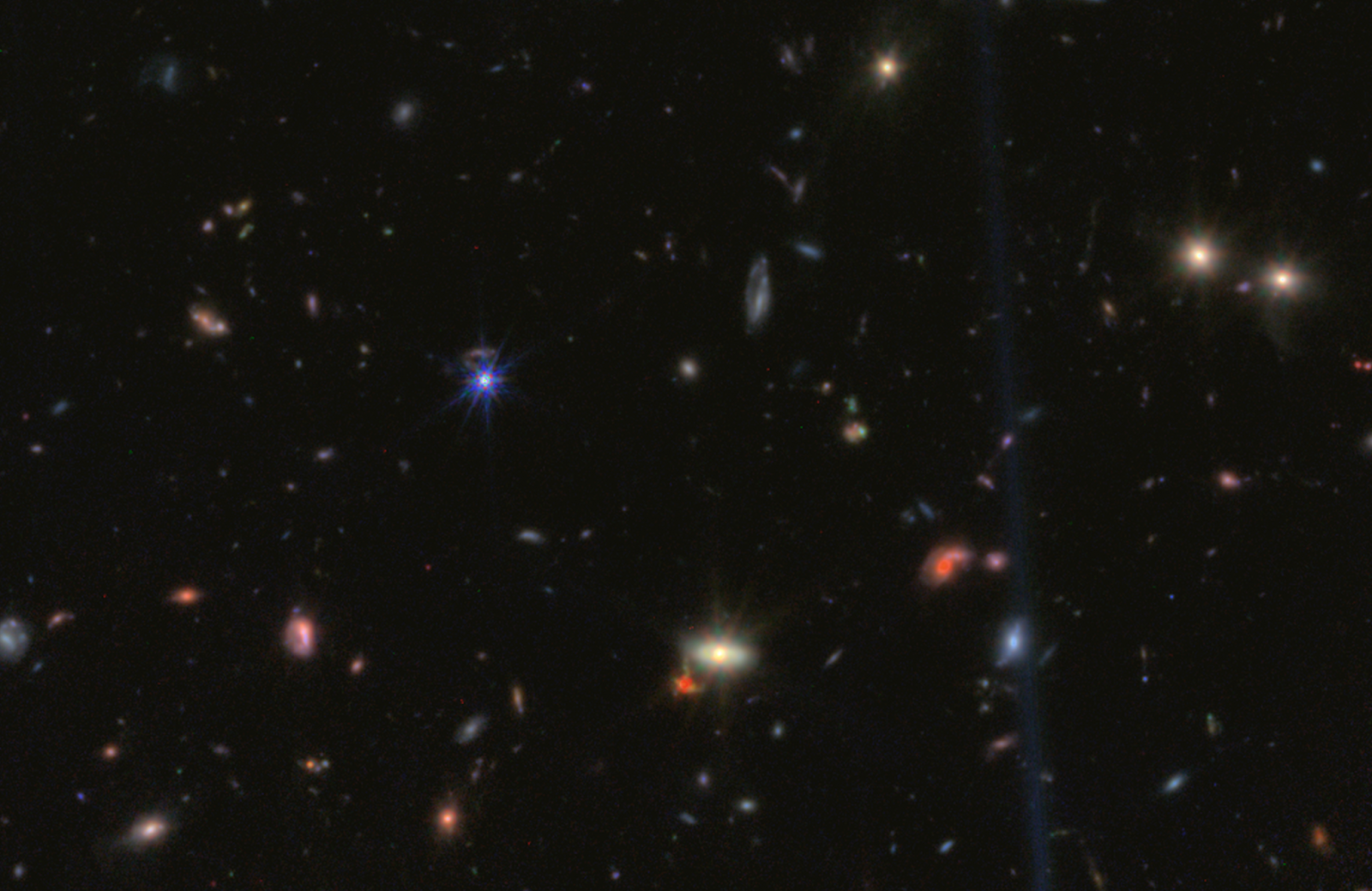
In other words, it’s not that these objects aren’t radiating in X-rays, it’s just that those wavelengths are largely blotted out by the gassy cocoons. Moreover, the cocoons warp light from the black holes, making them seem much more massive than they actually are, like some kind of cosmic funhouse mirror. Rusakov and his colleagues calculated that the black holes are probably a few million times as massive as the Sun, more than a hundred times smaller than expected by their appearance.
The findings are part of a wave of discoveries about the early universe primarily fueled by the unparalleled precision and sensitivity of JWST’s infrared vision.
“The first JWST observations caused several debates about how galaxies formed in the early universe, such as whether galaxies grow quicker than we thought,” Rusakov explained. “In fact, some of those initially problematic galaxies turned out to be Little Red Dots. As our study shows, they were misinterpreted as purely stellar galaxies and they are supermassive black holes instead.”
As JWST continues to expose strange new frontiers of the universe, astronomers can determine which anomalies point to novel entities and which, like the little red dots, turn out to be familiar objects going through an unfamiliar phase.
Either way, each breakthrough raises new questions. Rusakov and his colleagues may have identified the origin of the little red dots, but it remains unclear whether these young black holes grow faster than the galaxies associated with them, and what that might mean for our understanding of galactic evolution.
“LRDs show us what the black holes looked like a long time ago, and if we are lucky, they may show us how these massive black holes got started,” Rusakov said. “Just to be clear, even though they are likely the youngest black holes we ever found, they already have masses of a few million Suns.”
“This opens up the next big questions: can we find even smaller black holes with the James Webb Space Telescope? Do black holes start tiny and grow or are they born already quite big?” he added. “These exciting questions will definitely keep us busy for some time.”