
Welcome back to the Abstract! These are the studies this week that peacefully passed the crown, predicted trouble on the horizon, gave life after death, and coastally shelved an idea.
First, scientists watch a succession story play out for years in a naked mole rat colony. Then: prediction markets as a public health threat, the thorny questions of posthumous reproduction, and a walk on the shores of an ancient alien seas.
As always, for more of my work, check out my book First Contact: The Story of Our Obsession with Aliens or subscribe to my personal newsletter the BeX Files.
Digging into the palace intrigue of a rodent realm
Murderous queens. Bloody power struggles. Strictly enforced hierarchies. I’m speaking, of course, of naked mole rats, a bizarre species of rodent that becomes embroiled in violent conflicts over the succession of one breeding queen to the next.
Though aggression in succession is the norm for these animals, scientists now report a rare peaceful transition of power from one queen to her daughter in a captive colony.
The discovery suggests that “the less common peaceful trajectory to queen succession…is possible under some conditions” especially when “aggression-based enforcement may be insufficient or unnecessary and when the cost of a ‘war’ may be too high,” according to the new study.
As we’ve covered before on the Abstract, mole rats (both the naked kind and the non-naked kind) are the only mammals to live in eusocial colonies similar to bees or ants, meaning they are reigned over by one breeding queen and her subordinate workers. In addition to this unique social structure, mole rats display a number of fascinating behavioral and genetic adaptations, including long lifespans and low rates of cancer, which has made them a popular species for research.
Naked mole rats may not look all that intimidating, but when it’s time to anoint a new queen, the fur starts to fly (or it would, if these animals had any fur). If a queen dies or is deposed by rivals, subordinate females in the colony battle to take the throne.
But scientists co-led by Shanes Abeywardena and Alexandria M. Schraibman of the Salk Institute for Biological Studies observed a different succession story that unfolded over many years in the Amigos captive colony housed in San Diego.
Starting in 2019, a queen named Teré reigned over the colony and produced many healthy pups. Once the colony became crowded, with nearly 40 members, Queen Teré began delivering litters with no surviving pups. When the researchers removed half of the members, she began to produce surviving pups again, though not many. The team then deliberately introduced another stressor by moving the colony to a new facility in 2022, which ceased Queen Teré’s fertility.
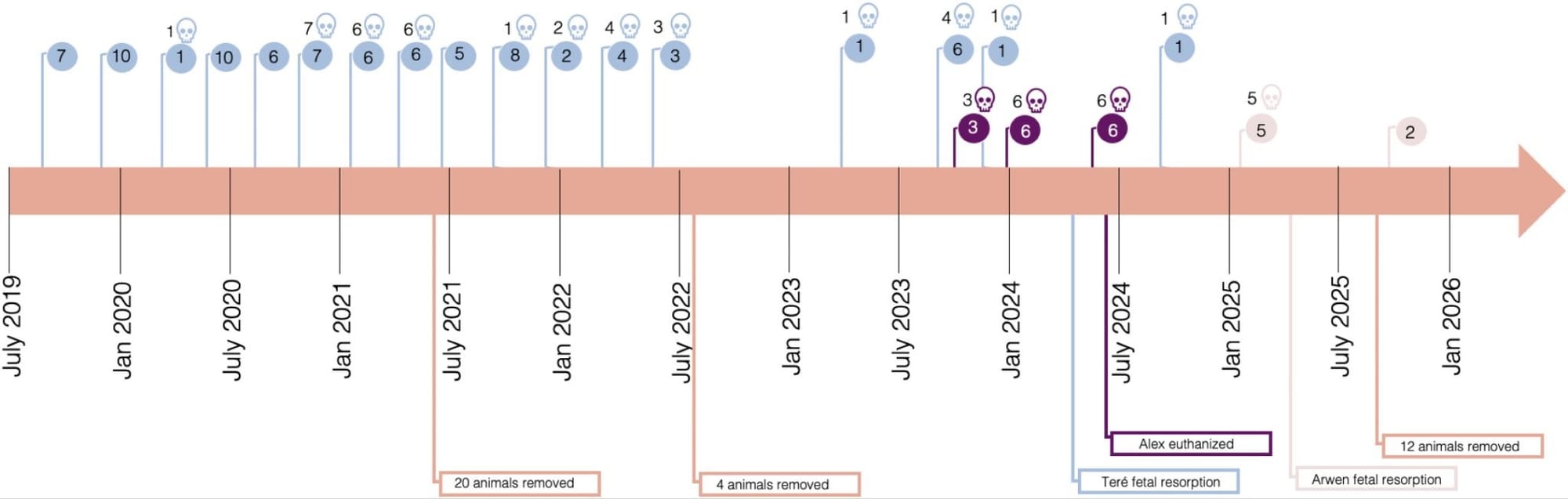
In response, Alexandria, one of Teré’s daughters, became pregnant in 2023 and 2024, but her litters also produced no survivors, and she had to be euthanized in 2024 due to a uterine torsion. Finally, the long reproductive hiatus was ended after three years by the ascension of Alexandria’s sister, Arwen, who became Queen Arwen upon her delivery of healthy pups in October 2025.
“Aside from a single incident on 6 February 2025 in which one animal was found with a superficial bite wound and dried blood around the face, an injury that resolved without recurrence, no aggression or dominance related conflict was observed,” the researchers said. “Instead, Queen Teré was reported to exhibit ‘guarding’ behavior of Arwen and her litter. No other signs of social instability, behavioral escalation, or colony-wide distress were documented.”
“Together, these observations indicate that following the decline of Queen Teré’s reproductive capacity and the loss of the intermediary breeder Alexandria, Arwen successfully assumed the reproductive role without eliciting aggression from the reigning queen or from other colony members,” the team concluded.
The study is an antidote to the story we covered last week about a lethal chimp “civil war,” demonstrating that animals with strict dominance structures choose peace over violence in some cases. My only note is that Teré’ be given the honorific Queen Mother for her service.
In other news…
The over/under on predication markets
Prediction markets (PMs) are exploding in popularity, but researchers warn that the “addictive design, vulnerable users, and permissive regulatory environments” that characterize these markets “are a well-established formula for population-level harm,” according to the Policy Forum section of the journal Science.
PMs operated by companies like Kalshi or Polymarket “pose underappreciated threats to democratic integrity” and are linked to “addictive behaviors,” according to authors Nizan Geslevich Packin of Baruch College Zicklin School of Business and Sharon Rabinovitz of the University of Haifa. For instance, PMs can enable insider trading about classified government information and expose millions of users to the risk of addiction and major financial losses.
“A public health approach reframes PM risks as predictable outcomes of environmental design, analogous to tobacco control’s success in treating smoking as population-level exposure rather than individual vice,” the team argued in the article.
“The window for precautionary action is closing,” the researchers emphasized. “Each week of billion-dollar PM activity…prolongs a large uncontrolled experiment on users.”
It remains to be seen whether this warning about the dangers of a wild new industry will materialize into meaningful regulatory action. Want to make a bet?
Creating new life after death
Posthumous children—children born after the death of one or both parents—are popular in myth and fiction, from the Greek Dionysus to more modern characters like John Connor or Daenerys Targaryen.
But this is also a real demographic of people that may evolve in interesting ways as reproductive technologies enable larger numbers of posthumous conceptions—in which the sperm and egg donors for an embryo may be deceased, such as the case of a boy born in 2018 whose mother and father had both died years earlier in a car crash.
In this way, “frozen sperm, eggs (or embryos) are, at one and the same time, both alive and dead,” said Sandra Bamford of the University of Toronto in a new anthropological study of the topic. “Through their frozen gametes and the potential of new kin connections in the future, the dead remain as active participants influencing the lives of the living.”
The study, which is part of a broader journal issue exploring kinship, pulls together many intriguing case studies, including the “Nuer ghost marriage” practices of Sudan, in which a deceased man can be considered the father of a kinsman’s children, or the case of William Kane, who bequeathed frozen sperm to his girlfriend, sparking a legal battle with his adult children after his death by suicide.
In other words, the legal, ethical, and practical implications of posthumous conception are still very much in flux, raising thorny questions about when, and how, the dead can produce new life. For instance: the ambiguities over judging the consent of a deceased person over the use of their posthumous gametes; the rights of posthumously conceived children to be named heirs of estates; and the possible emotional and psychological toll on posthumously conceived children, along with their family members.
The Rime of the Really Ancient Mariner
We’ll close, as all things should, with waves lapping on long-lost alien shores. The surface of Mars is etched with the memory of rivers, lakes, and perhaps even an expansive ocean that may have covered much of its northern hemisphere between three and four billion years ago.
Scientists have already mapped out the rough contours of what may be an ancient Martian shoreline, but a new study throws the seas into sharper relief by identifying topographic signs of a possible coastal shelf. The team argued in their study that these shelf features may be a better indicator of a past ocean than shoreline features, based on similar observations on Earth.

“Our results indicate that long-lived ancient oceans on presently arid planets may be best identified not only through discrete shorelines but also through…a global coastal shelf,” said researchers led by Abdallah Zaki and Michael Lamb of Caltech University. The study supports “the presence of an ancient ocean on the northern plains of Mars that was bounded by a coastal shelf.”
While this ocean dried up long ago, its topographic remnants are a reminder of a time when Mars was warm, wet, and perhaps, wriggling with life.
Thanks for reading! See you next week.